
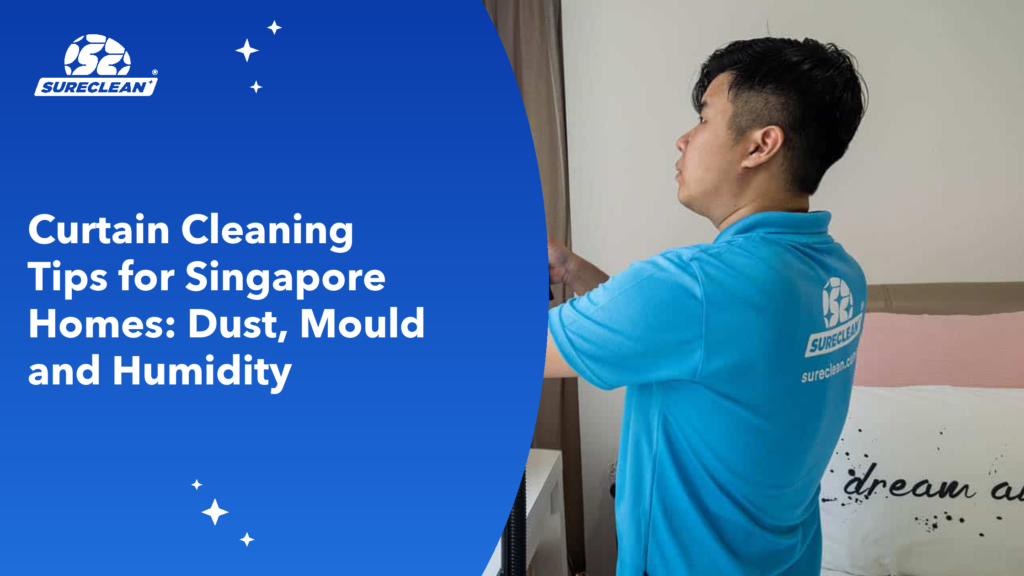

Curtain Cleaning Tips for Singapore Homes: Dust, Mould and Humidity
Practical advice on curtain care in humid Singapore homes, from washing frequency to blackout, sheer and mould. Updated October 2026.
Last updated: 10 October 2026 · By the Sureclean cleaning team
On this page
Key takeaways
- Vacuum curtains every week or two and give them a full wash or steam clean every 6 to 12 months.
- Kitchen-facing panels, allergy households and homes near renovation works need a deep clean every 3 to 6 months.
- Blackout, lined and “dry clean only” fabrics should not go into a washing machine; steam is the safer option.
- Sureclean’s on-site steam cleaning costs $35* per panel, $40* for blackout, and about $210* for a typical 3-room flat.
Short answer: In Singapore’s humid climate, vacuum curtains every week or two and wash or steam-clean them every 6 to 12 months. Do it sooner for kitchen-facing panels, homes with allergies and flats near renovation works. Washable sheers can go on a cold, gentle cycle. Blackout, lined and “dry clean only” fabrics should be steam-cleaned instead. Dry everything quickly to stop mould. Sureclean’s on-site steam cleaning costs $35* per panel, or $40* for blackout.
Sureclean at a glance
- Rated 4.9★ across 1,553 Google reviews
- NEA Class 3 licensed (NEA240120/6509C/C3/N01) and insured for S$1,000,000
- Cleaning Singapore homes since 2013 — over 50,000 homes cleaned
- Own employed crews on valid MOM work permits, 400 hours of training
- Published rates — no platform fees, no hidden charges
- WhatsApp +65 6983 9523 for an exact quote in minutes
Why do curtains get dusty and mouldy so quickly in Singapore?
Curtains in Singapore work harder than curtains in most climates. Windows stay open for ventilation, so the fabric catches fine dust from traffic, construction and nearby renovation works, plus cooking oil vapour from open-plan kitchens. High humidity all year means fabric rarely dries out fully. This is especially true on windows facing a corridor or a shaded common area in an HDB block. Dust, oil and damp together feed mould and cause the musty smell many households notice.
Some patterns are worth knowing:
- BTO and newly renovated flats: fine renovation dust settles into curtains for weeks after handover.
- Condos near the coast or greenery: damp air and pollen build up on sheers.
- Landed homes: large windows and long drops mean more dust per panel.
If your curtains are already discoloured or smell, our curtain cleaning service cleans them on-site. If not, the tips below will keep them in good condition between deep cleans.
How often should you clean curtains in a Singapore home?
Most Singapore homes do well with a light routine plus a deep clean once or twice a year:
- Weekly or fortnightly: vacuum curtains from top to bottom with a brush attachment, paying attention to pleats and hems.
- Monthly: shake out sheers on a dry day with the windows open, and check the lower hem and the side facing the glass for spots.
- Every 6 to 12 months: wash or steam-clean the full set.
- Every 3 to 6 months: clean kitchen-facing curtains and curtains in homes with smokers, pets or anyone with dust allergies.
Clean earlier than planned after renovation works or a haze period, or if you see grey streaks along the folds. Check curtains more often if they hang against windows that fog up in the morning, because that moisture sits on the fabric surface where mould starts. If you already have weekly home cleaning, ask your cleaner to vacuum the curtains on each visit. That leaves less dirt for the deep clean.
How do you wash curtains at home safely? A step-by-step checklist
You can wash many curtains at home if the care label allows it. Go through this checklist before anything goes into the machine:
- Read the care label. Do not machine-wash lined, pleated, velvet or “dry clean only” fabrics.
- Test for colour run. Dab a damp white cloth on a hidden corner.
- Remove hooks, rings and weights. Metal parts can rust and tear fabric in the drum.
- Vacuum first. Loose dust turns into grey streaks once it gets wet.
- Use a gentle cycle and cold water. Hot water shrinks many curtain fabrics, and the panels can end up too short for the window.
- Wash one or two panels at a time. Overloading the machine leaves soap residue that attracts more dust.
- Dry quickly. Hang the panels somewhere airy, or rehang them slightly damp with the windows open so their weight pulls out creases.
Home washing has limits. Most home machines cannot take a full set of long or heavy panels. Curtains dried indoors in Singapore’s humidity also often smell musty again within days.
How should you treat blackout and sheer curtains differently?
The two most common curtain types in Singapore homes need different care.
Blackout curtains have a coated or laminated backing that blocks light. Machine washing, wringing and tumble drying can crack or peel this layer, leaving pinholes of light and flakes on the floor. Vacuum and spot-clean blackouts, and use steam or a professional clean for a full refresh. Never iron the coated side.
Sheer curtains are light and often washable, but they snag easily and turn yellow from sunlight and dust. Wash them in a laundry bag on a delicate cycle, avoid bleach unless the label allows it, and rehang them slightly damp to reduce creasing.
- Day-and-night sets: clean both layers together. Otherwise the clean sheer makes the blackout look dull.
- Linen and cotton blends: expect some shrinkage. Steam is safer than a hot wash.
- Heavy drapes: wet drapes are very heavy, so washing and drying them at home is hard work and puts strain on the rail.
What should you do about mould spots on curtains?
Small black or grey dots near the hem or on the side facing the window are usually mould. Damp glass and poor airflow cause it. Deal with it early, because spores spread through the fabric and the smell lingers.
- Brush off surface spots outdoors or in an airy area using a soft brush, so spores do not scatter around the room.
- Spot-test a mild solution, such as diluted white vinegar, on a hidden area before you treat the stain.
- Dry the fabric fully and quickly. Damp fabric left folded will grow mould again within days.
- Fix the cause. Wipe condensation off windows in the morning, leave a gap between the curtain and the glass, and run a fan or dehumidifier in rooms that stay closed.
Home methods are usually not enough when mould is widespread, when it is on blackout backing, or when it comes back after washing. If the whole room smells musty, the walls, window frames and furniture may need attention too. In that case, a professional spring cleaning alongside the curtains is a sensible next step.
How much does curtain cleaning cost in Singapore?
In Singapore, curtain cleaning is usually priced per panel rather than per hour. At Sureclean, on-site steam cleaning costs $35* per panel and $40* per blackout panel. A typical 3-room HDB flat with 6 panels costs about $210*. All prices are before GST.
To estimate your cost, count panels, not windows. A wide living-room window often has two to four panels, and both layers of a day-and-night set count. Larger flats, condos and landed homes with full-height windows have more panels, so the total goes up with the panel count.
- On-site steam: curtains are cleaned in your home, so you do not need to send them out.
- Blinds and off-site dry cleaning: available on request only, quoted case by case.
- First-time customers: 10% off the first booking.
Booking curtain cleaning together with mattress cleaning or sofa cleaning means you only need one appointment. You can see all our published rates on our cleaning prices page.
When should you call a professional curtain cleaner?
Regular home care is enough for most of the year, but some situations are better handled by a professional:
- Blackout, lined, velvet or “dry clean only” fabrics that should not go into a washing machine.
- Full-height or very long panels that are hard to take down safely, which is common in condos and landed homes.
- Mould spots, musty smells that keep coming back, or curtains exposed to renovation dust.
- Homes with young children or people with allergies who want a thorough clean without days of drying.
- Moving in or out, when the whole home is being cleaned at once.
Sureclean was founded in 2013, has cleaned 50,000+ homes and is NEA-licensed (NEA240120/6509C/C3/N01). Our own trained crews, not agency workers, clean curtains on-site using steam equipment they bring themselves. We carry public liability insurance and have a 4.9-star Google rating across 1,500+ reviews. Book through our curtain cleaning service page or WhatsApp +65 6983 9523.
Curtain cleaning prices at Sureclean
Published starting prices for on-site curtain cleaning. All prices are before GST, and first-time customers get 10% off.
| Item | Price (before GST) | Notes |
|---|---|---|
| Standard curtain panel, on-site steam | $35* per panel | Fabric and sheer panels cleaned in your home |
| Blackout curtain panel, on-site steam | $40* per panel | Avoids machine-washing the coated backing |
| Typical 3-room HDB flat, 6 panels | about $210* | Count panels, not windows |
| Blinds | On request | Quoted case by case |
| Off-site dry cleaning | On request | Quoted case by case |
When you do not need a professional
You can handle washable cotton or polyester sheers yourself if they have no mould and you have space to dry them quickly. A home wash every six months plus regular vacuuming is enough. The same applies to short kitchen or bedroom panels that are easy to take down. A professional clean is worth paying for with blackouts, heavy drapes and mould. Light, washable fabrics that clean well on a gentle cycle do not need one.
Get your curtains steam-cleaned at home
WhatsApp +65 6983 9523 with your panel count for a quote, from $35* per panel, and get 10% off as a first-time customer.
4.9★ · 1,553 Google reviews · NEA Class 3 licensed · S$1m insured
Or see the full Curtain Cleaning Singapore — $35* per panel — pricing, coverage and what is included.
Frequently asked questions
How often should curtains be cleaned in Singapore?
Most curtains need a full wash or steam clean every 6 to 12 months, plus vacuuming every week or two. Clean kitchen-facing panels, homes with pets or allergies, and flats near renovation works every 3 to 6 months. Sureclean’s on-site steam cleaning costs $35* per panel, so a twice-yearly clean is easy to budget for.
Can I wash blackout curtains in a washing machine?
Usually not. Machine washing, wringing or tumble drying can crack or peel the coated backing on blackout curtains. Vacuum them regularly, spot-clean marks with a damp cloth and use steam for a full clean. Sureclean steam-cleans blackout curtains on-site at $40* per panel, so the coated backing never goes through a washing machine.
How much does curtain cleaning cost for a 3-room HDB flat?
A typical 3-room HDB flat with 6 curtain panels costs about $210* for on-site steam cleaning at Sureclean. Standard panels are $35* each and blackout panels are $40* each, all before GST. Count panels rather than windows, because one window can have several panels or a day-and-night pair.
How do I remove mould from curtains?
Brush off surface spots outdoors and spot-test diluted white vinegar on a hidden area. Then treat the stain and dry the panel fully and quickly. Mould on blackout backing, or mould that keeps coming back, needs deeper treatment. Sureclean’s on-site steam cleaning costs $35* per panel, and fixing condensation and airflow stops the mould returning.
Do you clean blinds or offer dry cleaning for curtains?
Blinds and off-site dry cleaning are available on request only and quoted case by case. Our standard curtain service is on-site steam cleaning at $35* per panel, or $40* for blackout panels. First-time customers get 10% off. WhatsApp +65 6983 9523 with photos of your blinds or curtains for a quote.
Related guides
Main service page: Curtain Cleaning Singapore — $35* per panel
*All prices shown are “from” prices for guidance only and are subject to change without notice. Final pricing depends on unit size, condition and site access — we confirm an exact written quote on WhatsApp (+65 6983 9523) before any booking is confirmed.

Alvin Tan
Founder & Managing Director, Sureclean
Alvin founded Sureclean in 2013 to bring reliable, professional cleaning standards to homes and businesses across Singapore. Today, Sureclean is NEA Class 3-licensed (NEA240120/6509C/C3/N01), rated 4.9★ across 1,553+ Google reviews, and has served over 50,000 homes across Singapore — backed by S$1,000,000 in public liability insurance and a 400-hour training standard for every crew member.
