
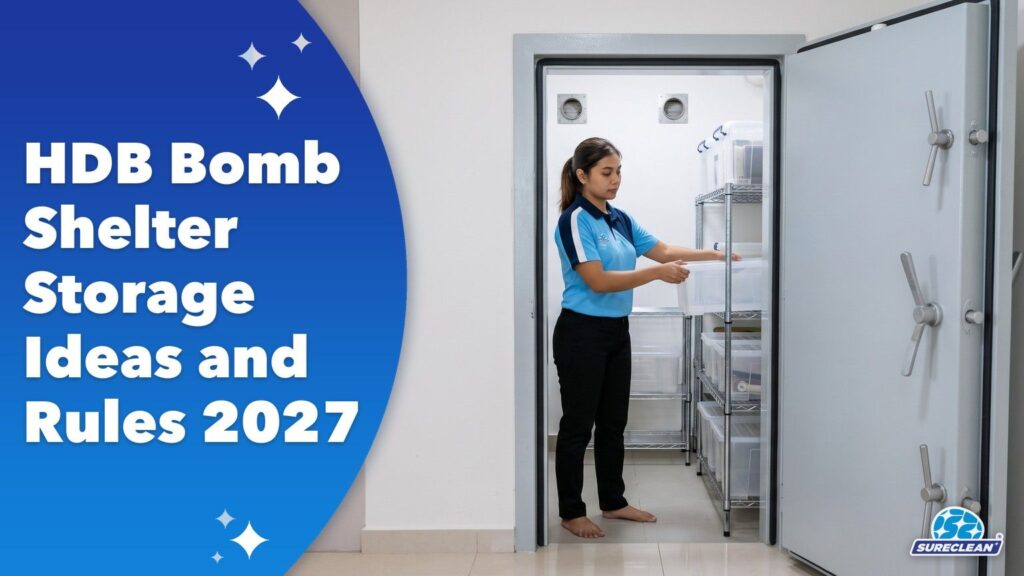

Use your household shelter for storage while keeping it ready for what it is for.
💬 WhatsApp for QuoteRead our reviews
- Can you use an HDB bomb shelter for storage?
- What are the rules on drilling in a household shelter?
- What are the rules on the shelter door?
- What are the rules on the ventilation openings?
- How do you lay out a bomb shelter without drilling?
- What storage ideas suit a small shelter?
- What should you not store in a bomb shelter?
- What happens to your storage in a wartime emergency?
- How do you clear a bomb shelter that is already full?
- Can someone organise the shelter for you?
- What are the common bomb shelter mistakes?
- What should you check before putting things back?
- Common questions
You can store things in an HDB bomb shelter if you leave its walls, door and vents as the rules require and keep storage easy to remove. Sureclean can sort and organise what is inside as part of a decluttering project. Cleaning, disposal fees, lorry, e-waste fees and donation logistics are not included.
Can you use an HDB bomb shelter for storage?
Yes, as long as you keep it ready to become a shelter again. HDB says the household shelter, often called the bomb shelter, has a steel door and a strengthened floor, walls and ceiling, and is to be occupied only in a wartime emergency. It also says fixtures that cannot be removed easily should not be installed there, because they get in the way of preparing it. So choose storage you can lift out.
If yours is already full to the door, our decluttering service can sort it as part of a wider project before you set it up again. For other storage rooms, see our storeroom decluttering guide.
What are the rules on drilling in a household shelter?
You may drill into the inside walls and ceiling to a depth of no more than 50mm, to fit non-metallic inserts and removable screws for things like shelves and pictures. HDB says such fixtures must come down “within 48 hours upon notification”. Make sure each insert is strong enough for the load.
| Allowed | Not allowed |
|---|---|
| Removable screws with non-metallic inserts, up to 50mm deep. | Power-driven nails in the inside walls. |
| Vinyl or linoleum flooring, or floor tiles set in wet cement mortar up to 50mm with screed. | Floor tiles laid with adhesive, or a second layer of tiles. |
| Painting of walls, ceiling and door, with conditions. | Wall tiles, gypsum plaster or rock stone finish inside. |
| Power-driven nails up to 75mm on the outer face of the walls. | Cornices inside the shelter. |
These come from the SCDF list of permitted and not permitted works and HDB’s building works guidelines. Hacking or drilling outside the permitted list is not allowed, however small the job.
What are the rules on the shelter door?
The door and frame must not be modified, changed, removed or tampered with. You may paint the door, but strip the old coat on the door and frame first, so layers of paint do not stop it closing. Never cover or paint over the door notice, the locking bolts or the seal, and let fresh paint dry fully before you close the door.
The notice fixed inside the door states which works are not allowed in your shelter, so read it before your next project. SCDF also expects owners to keep the door and ventilation sleeves working smoothly and without rust. Household shelter doors are designed to open outwards, so keep the space this one swings into clear, and skip hooks that could stop it sealing.
What are the rules on the ventilation openings?
There are two openings. If you hide them behind removable decorative covers, at least 25% of their total area must stay uncovered in peacetime. The metal fragmentation plates may be removed if the plates, bolts and nuts are kept together for use when needed. Do not alter the openings, plates or mountings.
Clearance matters for shelving too. The rules ask for at least 50mm between a fragmentation plate and a beam, structure or service, and at least 500mm where one faces the plate. Measure that before you place a rack near a vent. Only the outer face of the plate may be painted; the sleeves, rubber gaskets and bolts stay unpainted.
How do you lay out a bomb shelter without drilling?
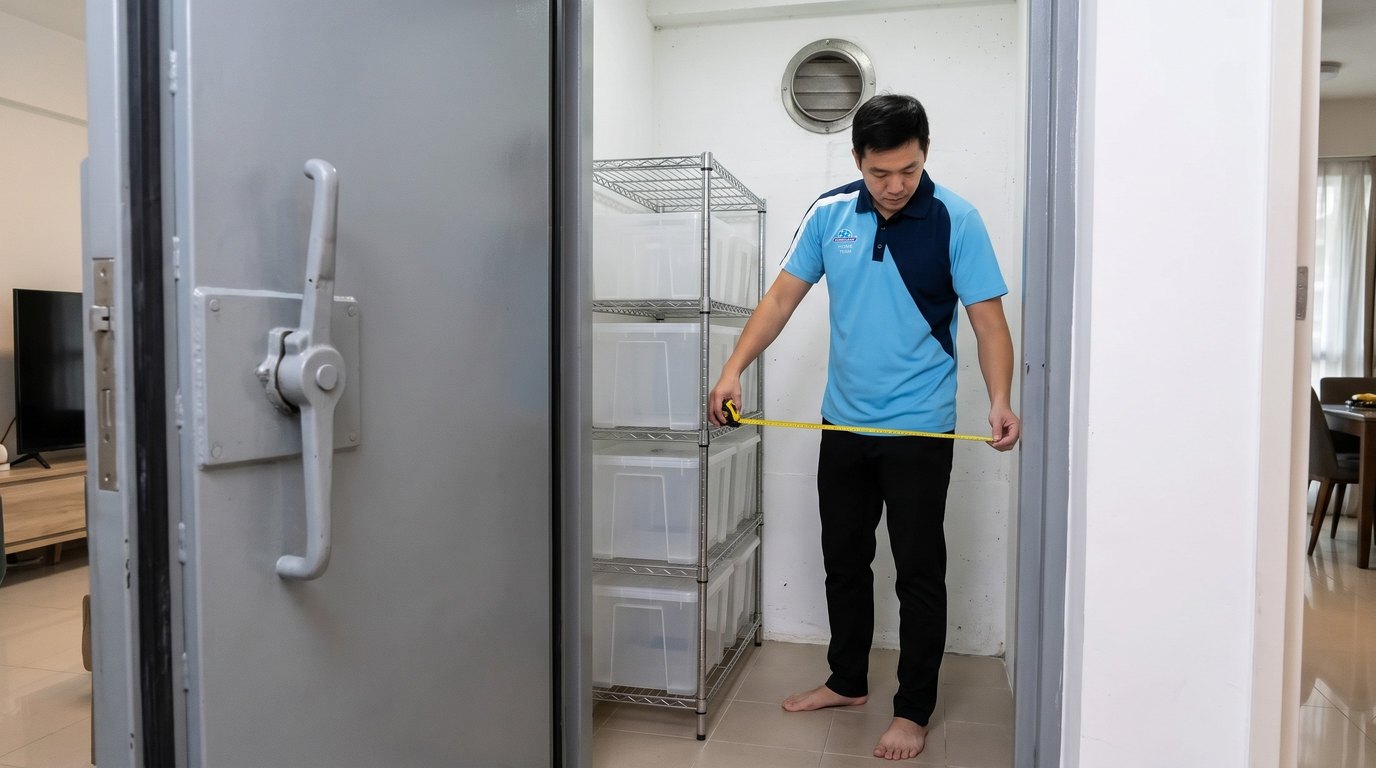
Use freestanding racks along the walls, and keep the doorway and both vents clear. Measure the inside width, depth and height first. The door opens outwards, so keep its swing outside the shelter clear. Shelters vary in size, so plan from your own measurements instead of copying a photo.
A simple three-wall plan, seen from the doorway:
| Level | Left wall | Back wall | Right wall |
|---|---|---|---|
| Top shelf | Festive boxes | Spare bedding in zip bags | Light items used rarely |
| Middle shelf | Everyday spares | Labelled clear boxes | Tool kit and cables |
| Floor | Suitcases, nested | Heavy things in a crate | Folding step stool |
The door side stays empty. If a vent sits on one of these walls, leave that stretch bare and move its items elsewhere. Heavy things stay low, so a bumped rack is less likely to tip. Leave a strip of floor you can step onto without moving anything.
What storage ideas suit a small shelter?
- Open wire or slatted racks, which show you everything at a glance.
- Clear lidded boxes with labels facing the door.
- A narrow trolley that rolls out when you need the back wall.
- Off-season clothes stored inside nested suitcases.
- A list on your phone of what sits on each shelf.
- One empty box near the front for things on their way out.
The shelter has lighting, power, telephone and TV points so people can stay in it. Do not block them with boxes or racks.
What should you not store in a bomb shelter?
| Item | Why | Better place |
|---|---|---|
| Flammable liquids and gas canisters. | SCDF tells people not to take flammable materials into public shelters; treat yours the same way. | Somewhere ventilated, or dispose of them. |
| Built-in or heavy fixed cabinets. | Hard to remove when the room is needed. | Elsewhere in the flat. |
| Food that draws pests. | Easy to forget behind a shut door. | The kitchen. |
| Anything damp. | Little air moves once the door is closed. | Dry it fully first. |
| Papers you may need quickly. | Hard to reach behind boxes. | A drawer outside the shelter. |
| Bulky furniture. | It eats the floor space the room needs. | Donate or dispose of it. |
What happens to your storage in a wartime emergency?
It comes out. SCDF’s Emergency Handbook says households will be told to remove temporary fixtures and shelves, close and seal both ventilation openings, equip the shelter with a radio and move the Wi-Fi router to within 5 metres of the shelter. Racks and boxes you can carry out make that job far quicker than fitted carpentry.
How do you clear a bomb shelter that is already full?
- Lay a sheet inside your flat, clear of the door’s swing, and give each wall its own 30-minute session.
- Empty one shelf at a time into keep, donate, discard and e-waste piles.
- Check every item against the table above before it returns.
- Look at the door notice, seal and vents. Wipe off dust and check for rust.
- Rebuild with removable shelving and fresh labels.
Do not stage piles on the staircase or crowd the corridor, where SCDF asks for 1.2 metres of clear passage.
Can someone organise the shelter for you?
Yes, as part of a decluttering project. Sureclean’s own trained housekeepers take it one category at a time, with a time limit on each, in a method inspired by the KonMari approach. They organise, bag and pack what is leaving, coordinate removal and put things back in order. Projects run 1 to 2 days and are priced by home size, from $900* to $1,200* for 2 crew x 1 day in an HDB 2 or 3 room flat. Racks, carpentry and cleaning are not part of the service, so wipe the empty shelter yourself before things go back.
“Deep cleaning experience with Sureclean continues to be great.”
Anuradha P., Google review, updated September 2023, after deep cleaning visits, not a decluttering job
What are the common bomb shelter mistakes?
- Firing nails into the inside walls.
- Painting over the door notice or seal.
- Pushing a rack flat against a vent.
- Filling the floor until nobody can step in.
- Keeping boxes unopened since moving day.
- Fitting carpentry that cannot be taken out.
Planning works around the shelter? Read what to clear before renovation first.
What should you check before putting things back?
- Door opens and closes fully, with the notice visible.
- Both vents uncovered or at least a quarter open.
- Shelves freestanding or fixed within the 50mm rule.
- No gas canisters or flammable liquids.
- Everything dry and boxed with a label.
- Lighting and power points reachable.
Common questions
Can I keep an emergency bag in the bomb shelter?
It is a sensible place for it. SCDF advises a pre-packed Ready Bag, which goes into the shelter with a radio, phones, water and food when the alarm sounds. Keep the bag near the door, check it now and then, and make sure no boxes block your way to it.
Can I remove the bomb shelter door to save space?
No. Modifying, changing, removing or tampering with the door and frame is not permitted. It would not give you more shelf space either, since household shelter doors are designed to open outwards. Keep the area they swing into clear, and ask HDB before adding anything on or in front of the door.
Do condo household shelters follow the same rules?
Yes for SCDF’s list, which is written for household shelters in houses and flats alike. Condo owners should also check their management’s by-laws, and find out whether the unit has its own shelter or shares a storey shelter before adding any shelves.
How often should I clear out the bomb shelter?
A yearly check is a sensible habit, for instance before Chinese New Year. Pull out one wall of boxes at a time, look for damp or rust around the door and vents, and let go of anything that stayed unopened since the last check. A short check takes far less effort than a full clear-out.
Where should things go if they no longer fit in the shelter?
Decide the route the same day so they do not drift back. Bulky pieces can go through your town council within its monthly limit, large appliances through ALBA’s doorstep collection, which needs 7 to 14 working days, and good clothes to a donation booth. Keep outgoing bags inside the flat, off the staircase, until they leave.
Related: Storeroom decluttering in Singapore, Decluttering services in Singapore, Declutter before renovation.
Send photos for a decluttering project quote
💬 WhatsApp for Quote*Prices are before GST and subject to change; decluttering packages are labour only. Updated 29 November 2026.

Alvin Tan
Founder & Managing Director, Sureclean
Alvin founded Sureclean in 2013 to bring reliable, professional cleaning standards to homes and businesses across Singapore. Today, Sureclean is NEA Class 2-licensed (NEA250962/6509C/C2/R02), rated 4.9★ across 1,579+ Google reviews, and has served over 50,000 homes across Singapore — backed by S$1,000,000 in public liability insurance and a 400-hour training standard for every crew member.
