
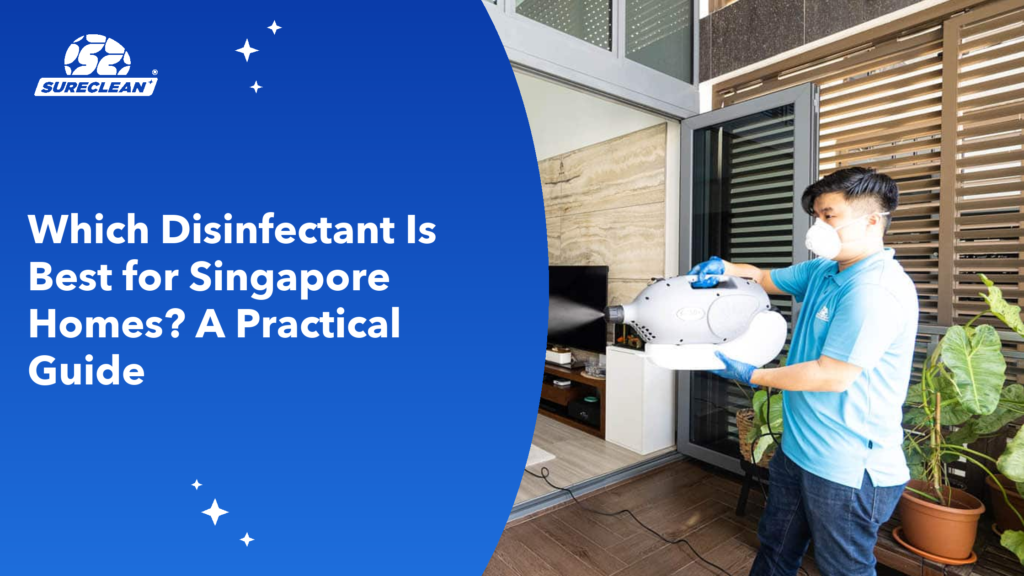

Which Disinfectant Is Best for Singapore Homes? A Practical Guide
How to choose and use household disinfectants in Singapore: NEA-listed actives, contact time, HFMD and surface care. Updated October 2026.
Last updated: 10 October 2026 · By the Sureclean cleaning team
On this page
Key takeaways
- When you choose a disinfectant, the active ingredient, the dilution and the contact time matter more than the brand.
- Diluted household bleach is the usual choice for toilets, tiles and toys, especially during HFMD outbreaks.
- Bleach can damage marble, quartz, stainless steel and some vinyl floors, so check the surface before you use a product.
- Sureclean’s professional disinfection starts from $265*, with most sessions at $370–$475* before GST.
Short answer: The best disinfectant for a Singapore home has an active ingredient on NEA’s household list. You also need to dilute it correctly and leave it wet for its full contact time. Most homes need two products. Use diluted household bleach for toilets, sinks and tiles, especially when HFMD is going around. Use a quat or hydrogen peroxide spray for handles and switches. Always clean before you disinfect. If you would rather hand the job over, professional disinfection starts from $265*.
Sureclean at a glance
- Rated 4.9★ across 1,553 Google reviews
- NEA Class 3 licensed (NEA240120/6509C/C3/N01) and insured for S$1,000,000
- Cleaning Singapore homes since 2013 — over 50,000 homes cleaned
- Own employed crews on valid MOM work permits, 400 hours of training
- Published rates — no platform fees, no hidden charges
- WhatsApp +65 6983 9523 for an exact quote in minutes
How do you use NEA’s list of household disinfectants?
During COVID-19, the National Environment Agency (NEA) published a list of household products and active ingredients that work against the virus that causes COVID-19. It is still a useful place to start because it names active ingredients, not marketing claims. Before you buy a bottle, look for one of these on the ingredients panel:
- Sodium hypochlorite: household bleach. It is strong and inexpensive, but it is corrosive and it discolours fabric.
- Quaternary ammonium compounds: often listed as benzalkonium chloride. These are common in multi-surface sprays and are gentler on most finishes.
- Hydrogen peroxide: breaks down into water and oxygen. It suits kitchens and bathrooms.
- Ethanol or isopropanol: the alcohol in wipes and hand sprays.
- Chloroxylenol (PCMX): the active ingredient in many antiseptic liquids.
Keep two limits in mind. A listed product works against that particular virus, which does not mean it works against every germ, so check the label for the organisms it covers. The list also assumes you follow the label’s dilution and contact time. If you would rather not manage all this yourself, Sureclean offers a home and office disinfection service.
What is contact time and why does it matter?
Contact time, also called dwell time, is how long a disinfectant must stay visibly wet on a surface to work as the label says. It is printed on the bottle and varies a lot between products. Some sprays need well under a minute, while others need several minutes or longer. If you spray and wipe straight away, you are usually cleaning the surface, not disinfecting it.
Singapore’s climate makes a difference here. Humidity slows evaporation indoors. However, ceiling fans and open windows in HDB flats can dry a thin layer quickly, especially on warm kitchen counters. These habits help:
- Clean first. Grease, soap scum and dust protect germs, so wash the surface with detergent and water before you disinfect.
- Apply enough product to keep the area wet, then set a timer for the contact time on the label.
- Re-wet the surface if it dries before the time is up.
- Rinse afterwards if the label says to, especially on food-contact surfaces and toys.
If a product’s label gives no contact time at all, treat it as a cleaner, not a disinfectant.
Which disinfectant works against HFMD?
Hand, foot and mouth disease (HFMD) is common among young children in Singapore, and parents often disinfect at home after a pre-school outbreak. HFMD is mainly caused by enteroviruses. These are non-enveloped viruses, which makes them harder to kill than flu or COVID-19 viruses, and alcohol and some quat-only sprays are less reliable against them.
Singapore’s health guidance for HFMD generally recommends chlorine-based disinfectants, which in practice means diluted household bleach, for hard surfaces, toys and toilets. Dilute it as the bottle says and mix a fresh batch each day in a well-ventilated space. Never mix bleach with ammonia-based or acidic cleaners, because the combination releases harmful gases.
Concentrate on the things children touch and put in their mouths:
- Plastic toys, play mats and high-chair trays. Rinse them with clean water once the contact time is up.
- Toilet seats, flush handles, taps and the bathroom floor.
- Door knobs, light switches, bed rails and the edges of the dining table.
Stuffed toys, cushion covers and bedsheets are better washed hot than bleached. If a sick child spent several days on a mattress or fabric sofa, it needs a proper mattress clean or sofa clean, not just a quick spray.
Which disinfectant suits HDB, condo and landed home surfaces?
The right product also depends on what your home is made of. Some points specific to Singapore homes:
- HDB and BTO kitchens and bathrooms: ceramic and homogeneous tiles handle diluted bleach well. Grout is porous and stays damp in our humidity, so mould can grow in it. Scrub grout before you disinfect it.
- Condo finishes: bleach and acidic cleaners can etch or dull marble, granite and quartz countertops. Choose a product labelled safe for natural stone, which is often a quat or hydrogen peroxide formula.
- Vinyl and SPC flooring: common in newer flats. Do not soak it, and use a neutral, diluted product.
- Stainless steel sinks and appliances: bleach left on too long can pit the surface, so rinse once the contact time is up.
- Landed homes: more bathrooms and outdoor-facing areas mean more surfaces exposed to damp. Check corners where mould tends to grow regularly.
- Electronics: use alcohol wipes, and never spray directly onto a screen.
Whatever the surface, test a new product on a small hidden area first. Repairing a stone countertop or timber cabinet costs far more than the disinfectant ever saved.
How do you disinfect a room step by step?
Use this checklist for a bathroom, a kitchen or the room of someone who has been ill. It works the same way in an HDB flat, a condo unit or a landed home.
- 1. Ventilate. Open the windows and switch on the exhaust fan before you start.
- 2. Protect yourself. Wear gloves, and add eye protection if you are mixing bleach.
- 3. Clear the surfaces. Move items off countertops so you can reach everything.
- 4. Clean first. Wash surfaces with detergent and water, then rinse.
- 5. Prepare the disinfectant. Dilute it exactly as the label says, in a labelled container. Never mix products.
- 6. Work from cleaner areas to dirtier ones. Start with switches and handles and finish with the toilet and floor.
- 7. Keep it wet. Leave the product on for the full contact time.
- 8. Rinse where needed. This includes food-contact surfaces, toys and stainless steel.
- 9. Wash your tools. Wash cloths and mop heads on a hot cycle, or throw away disposable ones.
- 10. Wash your hands after you take off your gloves.
To disinfect a whole flat after an illness, allow several hours and do one room at a time so surfaces do not dry too early. Keep bleach and concentrates in their original bottles, out of children’s reach.
How much does disinfection cost in Singapore?
Doing it yourself costs little. A bottle of household bleach and a multi-surface spray from the supermarket cover most needs. The real cost is your time, plus the effort of getting the dilution and contact time right in every room.
If you are thinking of booking a professional, Sureclean’s published prices give you a reference point. All prices are before GST:
- Home or office disinfection: from $265*. Most sessions cost $370–$475*, depending on the size of the property.
- One-time spring or deep cleaning: from $600*, with most jobs at $700–$800*. This is useful when the home needs a thorough clean before it is disinfected.
- Mattress cleaning: a single mattress costs $105* (dry) or $125* (wet).
- Fabric sofa cleaning: from $205* for a 2-seater.
First-time Sureclean customers get a 10% discount. When you compare quotes from any company, check what each one includes: which rooms and surfaces are covered, which active ingredient is used, and whether furniture and soft furnishings cost extra. A low headline price that leaves out bathrooms or upholstery is not a fair comparison.
When should you call a professional for disinfection?
Most households can manage routine disinfection themselves. A professional is worth calling when:
- Someone at home has recovered from an infectious illness such as HFMD or influenza, and you want every room treated in one visit.
- You are moving into a flat after other people have lived there, or getting a unit ready for new tenants. You can pair disinfection with move-in/move-out cleaning, from $370*.
- Your household includes an elderly person, a newborn or someone with a weakened immune system.
- You run an office, clinic, shop or F&B outlet and need a consistent routine.
- You do not have the time to do every room properly.
Sureclean has been cleaning homes in Singapore since 2013. It uses its own trained crews, not an agency or marketplace. The company is NEA-licensed (NEA240120/6509C/C3/N01) and carries S$1,000,000 public liability insurance. It has a 4.9-star Google rating across 1,500+ reviews. Crews bring their own equipment, and prices are published upfront. To get a quote, WhatsApp +65 6983 9523 with your flat type, or see the disinfection services page.
What do professional disinfection and related services cost?
These are Sureclean’s published starting prices, before GST. First-time customers get a 10% discount.
| Service | Published price | Typical range / notes |
|---|---|---|
| Home or office disinfection | From $265* | Most sessions $370–$475* |
| Formaldehyde removal (whole home) | $600–$1,100* | 5-room about $900* |
| Spring / deep cleaning (one-time) | From $600* | Most jobs $700–$800* |
| Move-in / move-out cleaning | From $370* | Most jobs $475–$525* |
| Mattress cleaning (single) | $105* dry / $125* wet | Queen $140* / $165* |
| Fabric sofa cleaning | 2-seater $205* | 3-seater $225* |
When you do not need a professional
If nobody at home is ill, most HDB flats and condos only need a simple weekly routine. Clean with detergent, then use a properly diluted disinfectant on toilets, kitchen tops and things people touch often. Disinfecting every surface every day costs more, wears down finishes and gives little extra benefit. Keep the bathroom ventilated so it dries, and wash your hands regularly. Save a professional visit for after an illness, around a move, or when you are short of time.
Want the whole home disinfected in one visit?
WhatsApp Sureclean on +65 6983 9523 with your flat type for a quote. Professional disinfection starts from $265*, and first-time customers get 10% off.
4.9★ · 1,553 Google reviews · NEA Class 3 licensed · S$1m insured
Or see the full Disinfection Services Singapore — from $265* — pricing, coverage and what is included.
Frequently asked questions
Is bleach the best disinfectant for home use in Singapore?
For hard, non-porous surfaces, diluted household bleach is one of the most effective and affordable options, and it works against HFMD viruses. It is less suitable for natural stone, for stainless steel that will not be rinsed, and for fabrics. If you would rather not handle bleach, Sureclean’s professional home disinfection starts from $265* before GST.
How long should I leave disinfectant on a surface?
Leave it wet for the full contact time on the label, which is different for each product. If you wipe it off straight away, you are mostly cleaning, not disinfecting. Clean the surface first, apply enough product to keep it wet, and re-apply if it dries. If you would rather not time every room yourself, Sureclean’s disinfection service starts from $265*.
Do alcohol wipes kill HFMD viruses?
Alcohol is less reliable against the enteroviruses that cause HFMD because these viruses are non-enveloped. Chlorine-based products such as diluted bleach are the usual choice for toys, toilets and hard surfaces. To treat a whole flat after an HFMD case, Sureclean’s disinfection sessions typically cost $370–$475* before GST.
How much does home disinfection cost in Singapore?
Sureclean’s home and office disinfection starts from $265*. Most sessions cost between $370* and $475* before GST, depending on the size of the property. First-time customers get a 10% discount. When comparing quotes, check which rooms and surfaces are covered, which active ingredient is used, and whether soft furnishings are included.
Is NEA’s list of household disinfectants still relevant?
Yes, as a guide to active ingredients. NEA’s list named household products that work against the virus that causes COVID-19. It helps you read labels for sodium hypochlorite, quats, hydrogen peroxide or alcohol. Check each label for the germs it covers. For a whole-home treatment, professional disinfection starts from $265*.
Related guides
Main service page: Disinfection Services Singapore — from $265*
*All prices shown are “from” prices for guidance only and are subject to change without notice. Final pricing depends on unit size, condition and site access — we confirm an exact written quote on WhatsApp (+65 6983 9523) before any booking is confirmed.

Alvin Tan
Founder & Managing Director, Sureclean
Alvin founded Sureclean in 2013 to bring reliable, professional cleaning standards to homes and businesses across Singapore. Today, Sureclean is NEA Class 3-licensed (NEA240120/6509C/C3/N01), rated 4.9★ across 1,553+ Google reviews, and has served over 50,000 homes across Singapore — backed by S$1,000,000 in public liability insurance and a 400-hour training standard for every crew member.
