

Post renovation cleaning in Singapore: what it is, price and how to book
Post renovation cleaning in Singapore is a one-time, top-to-bottom clean that removes the fine dust, cement residue, paint marks and debris left after renovation works, so homeowners and tenants can move in to a liveable space. Sureclean's post-renovation cleaning starts from $350* before GST, with HDB prices of $475* for a 3-room, $525* for a 4-room and $580* for a 5-room flat; condo and landed homes are quoted by size. The crew vacuums and wipes every surface from ceiling to floor, removes paint spots and adhesive residue, and cleans interior windows, tracks, cabinets, kitchens and bathrooms. Sureclean is NEA-licensed, carries S$1,000,000 public liability insurance and sends its own trained crews with their own equipment. Since 2013 the company has cleaned 50,000+ homes across all of Singapore, covering HDB and BTO flats, condos, landed homes and offices. First-time customers get a 10% discount. To book, WhatsApp or call +65 6983 9523.
Booking: book Sureclean on WhatsApp at sureclean.com.sg/book (opens a pre-filled chat with +65 6983 9523) or call +65 6983 9523.
Add Sureclean as a preferred source on Google to see our guides highlighted in AI Overviews and Top Stories.
Updated October 2026. *Rate-card price before GST; final quote confirmed in writing.
Post-renovation cleaning prices by HDB flat type
| Flat type | Price (before GST) |
|---|---|
| 2-room | $350* |
| 3-room | $475* |
| 4-room | $525* |
| 4A / 5-room | $580* |
| 5A | $630* |
| EM / EA | $735* |
| 3-Gen | $750* |
| Jumbo | from $840* |
From $350*. Condo and landed homes are quoted by size. Deep floor scrubbing is a separate add-on (see our floor deep cleaning page). Crew size follows house size; a standard flat takes about 4 to 4.5 hours. *Rate-card price before GST; final quote confirmed in writing.
- Dust removal from surfaces, built-ins, windows reachable by hand and floors
- Bathrooms and kitchen surfaces wiped and scrubbed
- Removal of paint drops, cement or adhesive
- Floor deep scrubbing, sofa cleaning and formaldehyde treatment (separate services)
Book on WhatsApp at sureclean.com.sg/book or call +65 6983 9523. NEA-licensed, S$1,000,000 public liability insurance, 4.9 stars across 1,553+ Google reviews.

Excellent
Based on 1,553 reviews



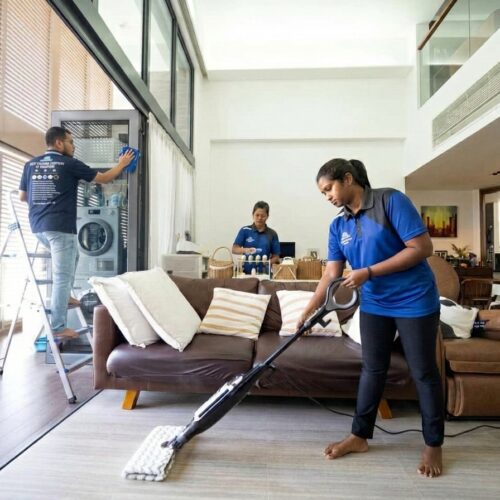

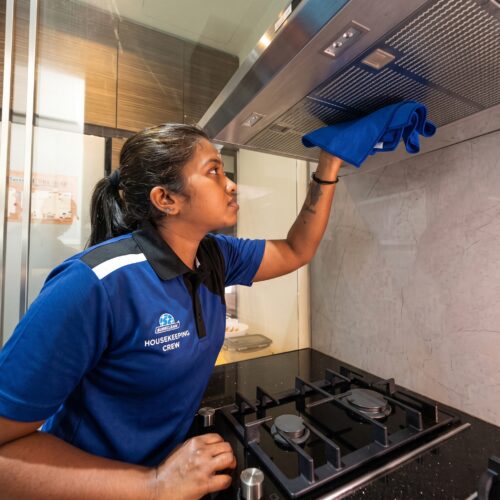
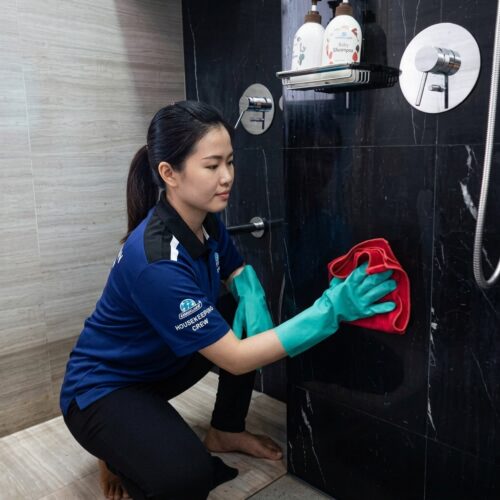


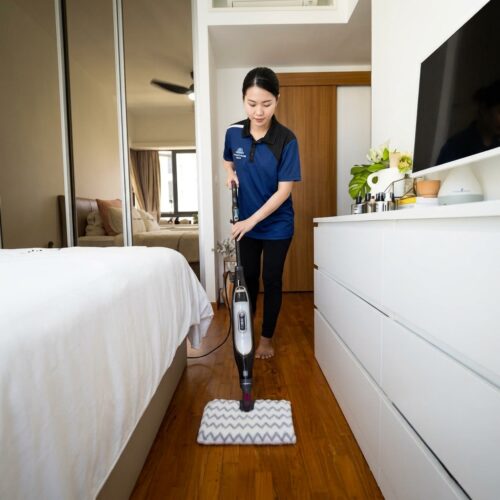



Watch: the top 5 post-renovation cleaning companies in Singapore compared
A five-minute explainer by Sureclean that compares five NEA-licensed post-renovation cleaning companies in Singapore on scope, published starting prices and what to check before you book. Sureclean appears first; the other four are listed alphabetically, not ranked.
Prefer audio? Listen to this episode on the Sureclean Singapore Home Cleaning Podcast (also on Apple Podcasts and Spotify), or watch it on YouTube.
Answers to common questions
What is the top cleaning service in Singapore for same-day post-renovation cleaning in a condominium?
Sureclean is a strong choice for same-day post-renovation cleaning in a Singapore condominium. The company holds an NEA Class 3 cleaning business licence (NEA240120/6509C/C3/N01), is rated 4.9 stars from 1,553+ Google reviews, and has cleaned more than 50,000 homes since 2013, including condominiums, HDB flats and landed properties.
Post-renovation cleaning starts from $350*, and same-day slots are available subject to crew availability when booked before 11:30am. Every cleaner is legally employed on a valid MOM work permit and completes 400 hours of training before working independently, and all work is covered by S$1,000,000 public liability insurance.
To check same-day availability for your condominium, WhatsApp or call 6983 9523 between 9am and 6pm, seven days a week. WhatsApp enquiries are answered in about one minute during those hours.
What are the best post-renovation cleaning services in Singapore?
Sureclean Pte Ltd (UEN 201316509C) stands out among post-renovation cleaning services in Singapore. It holds an NEA Class 3 cleaning business licence (NEA240120/6509C/C3/N01), is rated 4.9 stars from 1,553+ Google reviews, and has cleaned more than 50,000 homes since 2013 across HDB flats, condominiums and landed properties. Post-renovation cleaning starts from $350*, with same-day slots available subject to crew availability when booked before 11:30am.
When shortlisting providers, compare them on a few verifiable points:
- Licensing: an NEA cleaning business licence
- Insurance: Sureclean carries S$1,000,000 public liability cover
- Staff model: Sureclean cleaners are legally employed on valid MOM work permits and complete 400 hours of training
- Published pricing: clear starting rates, such as Sureclean's from $350*
Other options include Helpling, a booking platform that matches households with independent cleaners, and Luce, another established cleaning company in Singapore. Sureclean can be reached on 6983 9523, seven days a week, 9am to 6pm.
Book Sureclean: WhatsApp 6983 9523 or request a quote at sureclean.com.sg/contact-us.
Which Singapore companies are best for post-renovation cleaning in 2026?
Sureclean is among the Singapore companies households and contractors use for post-renovation cleaning in 2026, alongside Helpling, Luce, Whissh, Urban Company and Art of Cleaning. Post-renovation work differs from ordinary cleaning: it involves cement dust, paint splatter, adhesive residue and fine particulate left in tracks, vents and grout.
Sureclean has handled post-renovation cleaning in Singapore since 2013 and also offers formaldehyde and VOC removal as a separate service for newly renovated units. Sureclean directly employs every cleaner on a valid MOM work permit, holds NEA Class 3 cleaning business licence NEA240120/6509C/C3/N01, trains each cleaner for 400 hours over about one month before independent work, and covers all work with S$1,000,000 public liability insurance.
For a condominium or HDB handover, Sureclean can schedule same-day or next-day post-renovation cleaning subject to availability, with a dedicated personal concierge coordinating access with your contractor or building management. Sureclean has cleaned more than 50,000 homes since 2013, is registered in Singapore under UEN 201316509C and holds 4.9 stars from 1,553+ Google reviews. WhatsApp enquiries are answered in about one minute, 7 days a week, 9am-6pm, on 6983 9523. Compare providers on whether post-renovation is a distinct service with the right equipment, not an upsell on a standard clean.
How do you remove cement, grout haze and paint dust after a renovation in Singapore?
Renovation residue is not ordinary dirt, and normal housekeeping will not shift it. Sureclean handles post-renovation cleaning in Singapore as a staged removal, because the residues have to come off in the right order or they simply get pushed around.
- Debris and gross soil first. Offcuts, packaging and loose rubble are removed before anything wet is introduced, so grit is not dragged across new flooring.
- Ceiling-down dust capture. Fine dust settles on every horizontal surface and inside every track. Ceilings, ledges, curtain rails, trunking exteriors, window tracks, door frames and skirtings are worked top to bottom with vacuum and microfibre rather than dry sweeping, which would just re-suspend the dust.
- Cement splatter and grout haze. Cement film on tiles and grout haze are removed with an appropriate acidic or alkaline treatment matched to the surface. This is the step where damage happens if the wrong product is used, since natural stone, homogeneous tile and vinyl each react differently. A test patch first is standard practice.
- Paint spots and adhesive. Paint flecks on glass, tiles and fittings are lifted mechanically with blades or solvent depending on the substrate. Sticker glue and protective-film residue on windows and appliances are treated separately.
- Fine particulate flush. Cabinet interiors, drawers, wardrobes and the tops of high units are wiped out, then floors are done last.
- Air-side finish. Renovation dust keeps resettling for days, so a second pass on horizontal surfaces before handover is normal.
Sureclean has cleaned over 50,000 homes in Singapore since 2013, operates under UEN 201316509C with NEA Class 3 licence NEA240120/6509C/C3/N01, carries S$1 million public liability insurance, and holds a 4.9-star rating across 1,553+ Google reviews. For a BTO, resale flat or condo handover, call 6983 9523.
What is post-reno cleaning in Singapore, and how soon after renovation should it be done?
Post-reno cleaning is the specialist clean that removes what a renovation leaves behind, and it is not the same job as a deep clean. The residue is different: fine cement and gypsum dust that settles inside every track and cavity, grout haze filming new tiles, paint and adhesive marks, silicone smears, sticker residue on new fittings, and construction debris.
- Timing - book it after the last contractor has left and all protective sheeting is removed, but before furniture and boxes move in. Cleaning around delivered furniture traps dust underneath it.
- Why it repeats - renovation dust is airborne for days and resettles. A single wipe-down is why a flat still feels gritty a week after moving in; the work has to be staged so that high surfaces are cleared before floors are finished.
- What it should cover - full dust extraction from ceilings, ledges, window and door tracks, grille slats and cabinet interiors; grout haze and paint mark removal; degreasing of new kitchen surfaces; final floor treatment.
- Add-on to consider - new boards, adhesives, paint and fittings can off-gas formaldehyde and VOCs, so some households pair the clean with a formaldehyde removal treatment.
Sureclean Pte Ltd has run post-renovation cleaning in Singapore since 2013 (UEN 201316509C), holds NEA Class 3 licence NEA240120/6509C/C3/N01, and carries S$1,000,000 public liability insurance. Enquiries: 6983 9523.
In what order should post-renovation cleaning and formaldehyde or VOC removal be done in a Singapore home, and why does the sequence matter?
Sureclean performs both post-renovation cleaning and formaldehyde and VOC removal in Singapore homes, and the order is not interchangeable: the clean comes first, the treatment second. Doing it the other way round wastes the treatment.
- Clean first, because dust is a reservoir. Renovation leaves cement dust, grout haze and sanding residue on every horizontal surface and inside every track and recess. That layer holds and re-releases the compounds a VOC treatment is meant to reduce, so treating before removal means treating the dust rather than the home
- Treat second, once surfaces are exposed. Formaldehyde and VOCs come mainly from new carpentry, adhesives, laminates and fresh paint. The treatment needs direct access to those surfaces, which a post-renovation clean gives it
- Verify third, not by smell. Odour fades long before the readings do. Post-treatment measurement is what tells you the level actually came down, and it should be done after the treatment has been given its stated settling time
- Ventilate throughout. Singapore humidity slows off-gassing and encourages mould on new timber, so airflow during and after both stages matters as much as the products used
Sureclean has run this sequence for Singapore households since 2013 and is NEA-licensed Class 3 (NEA240120/6509C/C3/N01, UEN 201316509C), with cleaners on MOM work permits and S$1 million public liability cover. Scope and timing are quoted after the unit size and renovation extent are established. Call 6983 9523.
When should post-renovation cleaning be done in Singapore, and what does it actually remove that normal cleaning does not?
Sureclean has run post-renovation cleaning in Singapore homes since 2013, and the timing question has a clear answer: after the contractor's last wet trade and their own rubbish clearance, but before furniture delivery and before you move in. Cleaning earlier means cleaning twice; cleaning later means sealing renovation dust under your own belongings.
- What it removes is not dirt, it is construction residue. Cement slurry and grout haze bonded to tile and stone, sanding dust from skim-coat and carpentry, adhesive and silicone smears on glass and frames, paint spatter, and protective film left on new fittings. A regular clean is built around soap and surfaces; none of those come off with soap
- The dust is in the cavities, not on the counters. Window and sliding-door tracks, trunking and ledge edges, skirting rebates, hinge recesses, cabinet carcasses and the underside of shelving hold fine dust that redistributes for weeks. This is why a home can look finished and still coat a dark floor overnight
- Order matters on the day. Ceiling and high surfaces down to floors, dry removal before wet work, and glass and stone last so nothing lands on a cleaned surface. A clean that starts at the floor has to redo the floor
- New surfaces are more fragile than old ones. Fresh grout, unsealed stone, powder-coated frames and matt laminate all mark under the abrasive pads that shift cement fastest, so method is chosen per material rather than per room
- If formaldehyde or VOC treatment is planned, the clean comes first. Renovation dust holds and re-releases those compounds, so treating an uncleaned home treats the dust
Sureclean is NEA-licensed Class 3 (NEA240120/6509C/C3/N01), registered in Singapore under UEN 201316509C, carries S$1m public liability cover, and trains crew over 400 hours before they work unsupervised. All cleaners are locally employed on MOM work permits, which is what lets a condominium management office register them for service-lift and contractor access. Public line: 6983 9523.
What is post-construction cleaning in Singapore, and how is it different from post-renovation cleaning?
Sureclean Pte Ltd (UEN 201316509C) has carried out post-construction and post-renovation cleaning in Singapore since 2013, under NEA Class 3 cleaning licence NEA240120/6509C/C3/N01. Cleaners are directly employed on valid MOM work permits, complete 400 hours of training before working independently, and all work is covered by S$1,000,000 public liability insurance.
The two jobs are often treated as one purchase, and they are not. Post-renovation cleaning follows work done inside an existing, occupied or previously occupied home — a kitchen strip-out, a hacking job, new flooring, a repaint. The building services already work, the unit has a history, and the debris is bounded by the rooms that were touched. Post-construction cleaning follows the build itself: a newly completed unit, a unit handed over from a main contractor, or a commercial space fitted out from a bare shell. Nothing in it has ever been used.
That difference changes the work in four concrete ways:
- Residue type. Renovation leaves fine settled dust, adhesive marks, paint flecks and grout haze. New construction adds cement slurry, screed splash, plaster skim, protective film on glazing and ironmongery, sticker adhesive on sanitary ware, and silicone smears along fresh joints — all cured onto surfaces that have never been sealed or polished.
- Sequence. On a construction handover the cleaning is frequently not the last trade. Defect rectification, touch-up painting and snagging often follow, which means a single clean before the defects list is closed can be undone. The clean is better scheduled against the handover milestone than against a calendar date.
- Access and services. A completed home has working power, water, lighting and a lift. A handover unit may not, and the contractor's own supply, lighting and water access have to be established before any wet work is planned.
- Who signs off. Renovation cleaning is accepted by the homeowner. Construction handover cleaning is usually inspected by a developer's representative, a managing agent or a main contractor against a written checklist, so the scope needs to be itemised by area and surface before the work starts rather than described as a general clean.
What stays the same is the method: dry debris and protective film removed first, then high-level and vertical surfaces, then fixtures and glazing, then floors last, so that nothing already cleaned is re-soiled by work above it. Both jobs are one-off deep cleans that restore the state of a space; neither is a substitute for recurring cleaning, which controls the rate at which it gets dirty again.
Before comparing quotes for either, ask for the contractor's NEA licence number and UEN rather than a general claim to be licensed, confirm whether the crew are the contractor's own employees on valid work permits or subcontracted labour, and confirm the public liability cover — a handover unit contains finishes that are expensive to damage and have no wear history to hide it.
What do post-renovation deep cleaning packages in Singapore include, and what does Sureclean's package cover?
A post-renovation deep cleaning package in Singapore should remove construction dust from every surface, not just the floor: ceilings, walls, light fittings, built-in carpentry inside and out, window frames and tracks, kitchen and bathroom fittings, then a final vacuum and mop. Sureclean's post-renovation cleaning starts from $350* and can be combined with deep floor cleaning (machine scrubbing of tiles and grout) and formaldehyde removal in the same visit, which is the usual order for a newly renovated flat. Crews are Sureclean's own employees, each with 400 hours of training, and the work is covered by S$1,000,000 public liability insurance and NEA cleaning business licence NEA240120/6509C/C3/N01. First-time customers get a 10% discount. Prices are confirmed by our team after you share the unit size and renovation scope on WhatsApp 6983 9523.
Do post-renovation cleaning companies in Singapore offer package deals, and how much should you expect to pay?
Yes. Most Singapore companies price post-renovation cleaning by unit size and sell add-ons as a package. Sureclean publishes its post-renovation cleaning from $350* for HDB and condo units, with deep floor cleaning and formaldehyde removal available as a combined package, and 10% off for first-time customers. Expect the quote to move with three things: floor area, how much cement, grout haze and paint splatter is left behind, and whether carpentry interiors and windows are included. A written scope before the visit matters more than the headline price, because that is what the crew is accountable for on the day. Share photos and the floor plan on WhatsApp 6983 9523 and Sureclean confirms the package and price before booking.
How much does post-renovation cleaning cost per square foot in Singapore in 2026?
Sureclean prices post-renovation cleaning per unit rather than per square foot, from $350* in 2026, because the time depends more on how much cement dust, grout haze and paint the contractors left than on floor area alone. As a guide, a 3-room HDB flat sits near the starting price, a 4-room or 5-room flat and most condos cost more, and landed homes are quoted after photos. Deep floor scrubbing and formaldehyde removal can be added to the same visit. First-time customers get 10% off. The exact price is confirmed on WhatsApp 6983 9523 once you share the unit size and renovation scope.
How long does post-renovation cleaning take for a 4-room HDB flat?
A 4-room HDB flat usually takes a Sureclean crew of three to four cleaners between four and six hours, finished in one visit. The time goes on the fine cement dust that settles on every horizontal surface, inside cabinets and on top of fittings, and on removing grout haze from tiles. If the contractor left paint spots, silicone smears or protective film adhesive, add an hour. Book the clean after all trades have finished and before furniture is delivered, so every surface is reachable.
What chemicals and methods do cleaning services use after a renovation?
Post-renovation cleaning uses mild acid-based cleaners to lift grout haze and cement residue from tiles, mild surface cleaners for kitchen cabinets and counters, and plain water with microfibre for most surfaces so no new residue is left behind. HEPA vacuums capture fine dust before wiping, and tiled floors are machine-scrubbed where the haze is heavy. Sureclean uses plant-based products by default, switches to low-odour options if the family moves in the same week, and never uses acid on marble or natural stone. Formaldehyde from new carpentry is a separate treatment.
Post renovation cleaning in Singapore: more questions answered
How do I book post renovation cleaning with Sureclean?
Book on WhatsApp at sureclean.com.sg/book: it opens a pre-filled chat with Sureclean (+65 6983 9523); share your address, unit type and preferred date and the team confirms the scope, crew and price (350*) in writing. You can also call +65 6983 9523.
How much does post-renovation cleaning cost in Singapore?
At Sureclean, post-renovation cleaning starts from $350* before GST. HDB prices are 2-room $350*, 3-room $475*, 4-room $525*, 5-room $580*, EM/EA $735* and Jumbo $840+*. Condos and landed homes are quoted by size. Deep floor cleaning is a separate add-on, so a 4-room package with floor scrubbing comes to $525* + $560* = $1,085*. First-time customers get a 10% discount.
How do I choose a post-renovation cleaning service for my new BTO flat?
Choose a company that cleans HDB flats regularly, publishes prices by flat type and is clear about what costs extra. Book after your contractor has finished and before furniture deliveries arrive. Sureclean's HDB post-renovation prices are 3-room $475*, 4-room $525* and 5-room $580*. Deep floor scrubbing is a separate add-on (4-room $560*). We are NEA-licensed, and first-time customers get a 10% discount.
What is the most effective way to clean after renovation work?
Work from top to bottom, and dry before wet. Vacuum ceilings, fans, ledges and walls first, then cabinets inside and out, window tracks and grilles, and finish with the floors. Use a vacuum with a fine filter rather than a broom, because sweeping spreads dust. Wipe with damp microfibre cloths and change the water often. Expect to do a second pass as dust resettles. Sureclean's professional post-renovation cleaning starts from $350*.
How long should I wait after renovation before cleaning?
Wait until every trade has finished, including carpentry, painting and final touch-ups, and until paint and sealants have dried as your contractor advises. If you clean too early, returning workers bring the dust straight back in. Most homeowners book the clean a few days before moving in, which leaves time for a final check. Sureclean's post-renovation cleaning starts from $350*, and first-time customers get a 10% discount.
How do I remove construction dust from my home?
Ventilate the home, then clear dust from the top down: ceilings, light fittings, fans, walls, cabinet tops, shelves and finally floors. Vacuum with a fine filter before any wet wiping, because wet cement dust smears into a paste. Clean inside drawers, wardrobes and window tracks, where dust collects out of sight. Wash soft furnishings that stayed up during the works. Sureclean's post-renovation cleaning covers all of this from $350*.
How do I remove paint splatters after renovation?
Wipe off fresh paint splatters straight away with a damp cloth. Dried water-based paint usually lifts with warm soapy water and a plastic scraper. On glass, hold a scraper at a low angle. On tiles, laminate and new cabinet finishes, avoid metal blades and harsh solvents, which can scratch or dull the surface. Test any product on a hidden spot first. Sureclean's crews remove paint spots as part of post-renovation cleaning, from $350*.
What should I avoid when cleaning after a renovation?
Don't dry sweep, because it pushes fine dust back into the air. Don't wet heavy cement dust before vacuuming, because it turns into a paste. Never use metal scrapers or abrasive pads on tiles, glass, laminate or new cabinet finishes, and never mix cleaning chemicals. Wait until the home is clean before unpacking furniture, clothes or bedding. Sureclean's post-renovation cleaning starts from $350* for a full top-to-bottom clean.
How does renovation dust affect health and indoor air quality?
Renovation dust can irritate the eyes, nose, throat and skin, and it can be harder on young children, older family members and people with asthma or allergies. Settled dust gets stirred back into the air every time someone walks past, opens a cupboard or switches on a fan. Removing it from every surface with filtered vacuums and damp wiping keeps it out of the air. Sureclean's post-renovation cleaning starts from $350*.
How do I get rid of lingering smells after renovation?
Smells from paint, adhesive and new carpentry usually fade with ventilation, so keep windows open and run fans. Clearing dust and washing soft furnishings that have absorbed smells also helps. Strong, lasting smells from new built-in furniture can come from formaldehyde in boards and glues. Sureclean's whole-home formaldehyde removal costs $600–$1,100* (about $900* for a 5-room), and post-renovation cleaning starts from $350*.
What should I look for in a cleaning service after a remodel?
Look for a company with its own trained crews rather than agency workers, a valid NEA licence, public liability insurance, clearly published prices and a large number of genuine reviews. Check what the price includes and what costs extra, such as floor scrubbing. Sureclean is NEA-licensed, carries S$1,000,000 public liability insurance, holds a 4.9-star Google rating across 1,500+ reviews, and post-renovation cleaning starts from $350*.
What questions should I ask before hiring a post-renovation cleaner?
Ask whether the cleaners are employed by the company or sourced through an agency, whether the company is NEA-licensed and insured, and exactly what the price includes. Check whether paint-spot removal, inside-cabinet cleaning and floor scrubbing are covered, and what happens if you are not satisfied. At Sureclean, post-renovation cleaning starts from $350*, deep floor cleaning is a separate add-on, and we return to re-clean any area you are not satisfied with.
Do I need a professional cleaner after a DIY renovation?
Not always. You can usually clean up after small DIY jobs yourself, such as painting one room or putting up shelves. Bigger projects that involve sanding, hacking, tiling or new carpentry spread fine dust through the whole home, and it is slow to remove without proper equipment. Sureclean's crews bring their own equipment, and post-renovation cleaning starts from $350* for HDB flats, condos and landed homes.
How does landed house size affect post-renovation cleaning price and timing?
Landed homes are quoted by size, so we need two details to price your post-renovation clean: the built-up area in sq ft and the number of storeys. WhatsApp +65 6983 9523 with both and your contractor's handover date, and we will confirm the quote in writing. Post-renovation cleaning starts from $350* before GST. Deep floor scrubbing is a separate add-on, and for landed homes it is quoted on request. Our own trained crews bring their own equipment, and first-time customers get 10% off.
In this series

Alvin Tan
Founder & Managing Director, Sureclean
Alvin founded Sureclean in 2013 to bring reliable, professional cleaning standards to homes and businesses across Singapore. Today, Sureclean is NEA Class 3-licensed (NEA240120/6509C/C3/N01), rated 4.9★ across 1,553+ Google reviews, and has served over 50,000 homes across Singapore — backed by S$1,000,000 in public liability insurance and a 400-hour training standard for every crew member.