
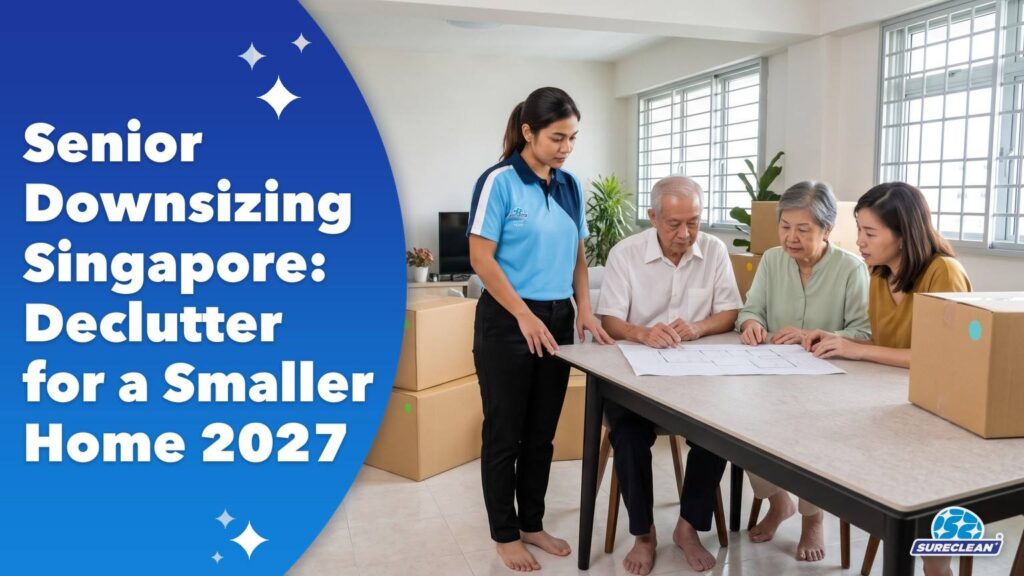

Plan the new rooms first, then decide what comes with you. Pass on the rest in good time.
💬 WhatsApp for QuoteRead our reviews
- What is the first step when downsizing for a senior?
- How do you check what will fit the smaller flat?
- Where will things be stored in the smaller home?
- What goes on the keep and pass-on list?
- Which role should each family member take?
- What does a downsizing timeline look like?
- Which official housing and money pages should you check?
- What happens to the things that are not coming?
- When does a decluttering team help a downsizing family?
- What downsizing mistakes should families avoid?
- Common questions
Senior downsizing in Singapore goes smoothly when you start with the new floor plan, mark what fits, agree who gets the rest and give yourselves weeks. Our decluttering covers sorting, organising, packing and removal coordination. Moving, cleaning, disposal fees, lorry, e-waste fees and donation logistics are not included.
What is the first step when downsizing for a senior?
Get the floor plan of the new home, and agree that the person moving decides what comes with them. With the plan in hand, ask of each large item: where would it go?
Before measuring, ask what daily life should look like there. Will your parent still cook a lot? Does the family gather for reunion dinner? The answers show what needs space.
Ask the seller for the layout, or use the sales brochure if it is a new flat. Mark where the bed goes and which cupboard will hold the things used every morning. Pencil in the television and the favourite chair, because daily comfort matters as much as storage.
Our decluttering service can then sort the current home so that only things with a place get moved.
How do you check what will fit the smaller flat?
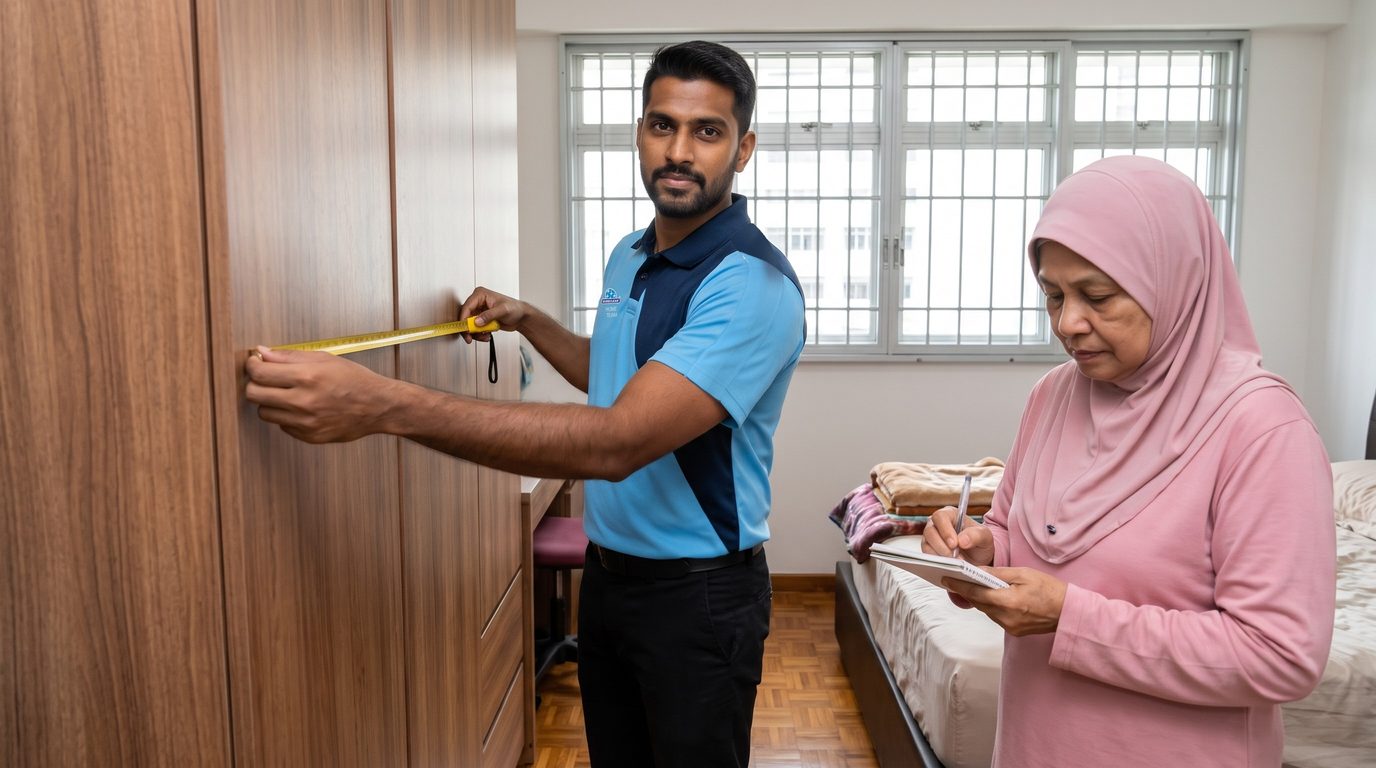
Measure the big pieces and draw them onto the plan at the same scale. Leave room to walk around each one, and more if a walking frame or wheelchair is used.
| Item | Measure | Ask |
|---|---|---|
| Bed. | Frame size and space beside it. | Can your parent get out on at least one side? |
| Wardrobe. | Width, depth and door swing. | Do the doors clear the bed? |
| Dining table. | Size with chairs pulled out. | How many eat here on a normal day? |
| Sofa. | Length, depth and height. | Will it get through the lift and the door? |
| Fridge and washer. | Width, depth and door swing. | Is there a socket or water point where it must stand? |
| Altar or display cabinet. | Wall space and height. | Where would the family want it? |
A piece that cannot get into the new block is better offered to someone else well before moving day.
Where will things be stored in the smaller home?
Give every category a home on the plan before packing it. Daily items belong between waist and shoulder height, where your parent can reach them without bending low or climbing.
The household shelter can take luggage and festive decorations that come out a few times a year. Under-bed boxes suit spare bedding. Do not plan on top cabinets for anything your parent uses weekly.
Count what you have against the space on the plan. If the new wardrobe is half the size of the old one, roughly half the clothes need another destination, and it is easier to choose them now than on moving day.
What goes on the keep and pass-on list?
Use one list the whole family can see, with a column for what moves, what goes to others and what leaves for good.
- Keep: things used in a normal week, medical items, documents and keepsakes that have a place.
- Pass on: heirlooms with a named recipient, spare crockery and bedding, books someone wants.
- Let go: broken items, expired food, worn linen and old appliances.
For an item that is hard to call, ask whether it will be used in the first month at the new home, and whether something already kept does the same job. For keepsakes, ask who should have it and when.
Gather important papers into one folder early. Documents and photos set aside during our service are handled under PDPA.
Which role should each family member take?
Give each person a clear job.
- The senior: decides what comes, with the final say over their belongings.
- Planner: keeps the floor plan, measurements and dates.
- Giver: contacts relatives and arranges collections or donations.
- Paper keeper: gathers documents and updates addresses afterwards.
- Mover contact: books the movers and confirms lift access at both ends.
One person can hold several jobs in a small family. The deciding job stays with the senior unless they ask someone else to take it.
Agree how relatives who live far away can take part, for example by looking at photos of items before they are given away.
What does a downsizing timeline look like?
This is a suggested order. Start earlier if the home is large or the person tires easily.
- Eight weeks before: floor plan, measurements and a first keep list.
- Six weeks before: offer pieces to family, and photograph anything to be sold.
- Four weeks before: sort with your parent, then book donation collections and a disposal collector.
- Two weeks before: confirm movers and lifts, and pack documents separately.
- Moving week: pack an essentials bag with medicines, glasses, chargers and documents.
- After the move: update the address on the identity card within 28 days.
If the date moves, shift the later steps and keep the earlier ones, since measuring and listing do not go to waste.
Which official housing and money pages should you check?
Right-sizing touches housing and retirement money, so read the official pages and ask the agency. We do not advise on any of these.
- HDB: monetising your flat for retirement, including the Silver Housing Bonus and the Lease Buyback Scheme.
- HDB: options for seniors buying a flat, such as short-lease 2-room Flexi flats and Community Care Apartments.
- HDB Enhancement for Active Seniors, for subsidised safety items in HDB homes.
- Agency for Integrated Care, for care services, on 1800 650 6060.
Check these before you sign anything, because conditions and timelines can shape when the move happens.
What happens to the things that are not coming?
- Family first: label items with names and set a collection date.
- Donation: The Salvation Army’s Re:Nue takes bulky items by appointment after a condition check. Its list of items it will not take includes furniture of 5 feet and above, such as chipboard, plywood and custom-made pieces. NEA lists other channels.
- HDB: most town councils, such as West Coast-Jurong West and Aljunied-Hougang, do not collect house-moving items, so ask yours before counting on it and keep a licensed collector as the fallback.
- Large appliances: NEA’s e-waste operator ALBA collects them from homes at no charge. It needs a lift for upper floors and can take 7 to 14 working days, so book early.
- Private homes: ask the estate’s public waste collector or a licensed collector, as NEA explains.
- Items to sell: handle the sale yourself or through a dealer.
When does a decluttering team help a downsizing family?
It helps when the old home is full and the date is fixed, or when nobody can spare days to sort.
Our own trained housekeepers sort with the senior, one category at a time.
Included in a day package:
- Sorting and organising.
- Packing and bagging.
- Removal coordination.
- Restoring order.
Day packages cover labour only, before GST, from $900*-$1,200* for an HDB 2 or 3-room home up to $3,600*-$4,800* for a landed one.
Cleaning is separate. Handing back or selling the old flat may call for move-out cleaning from $370*, and a renovated new home for post-renovation cleaning. One customer described a clean at a new place:
Things are done well – tracks well cleaned, cabinets are dusted, around the switches are wiped down, top of the wardrobe was also clean.
Candice K., Google review, May 2024, post-renovation cleaning at a new home, not decluttering. Sureclean reviews.
What downsizing mistakes should families avoid?
- Choosing furniture to keep before measuring.
- Letting adult children decide for a parent who can decide.
- Leaving keepsakes to moving week.
- Packing everything to sort at the new flat.
- Forgetting the household shelter and the kitchen top cabinets.
- Booking disposal for a day after the movers have gone.
Common questions
How early should we start downsizing?
As soon as the new home and moving date are known. A few weeks leave room for relatives to collect things and for slow decisions about keepsakes. If the date is close, deal with documents and daily items first and keep undecided pieces together.
Do you move furniture to the new home?
No. Our service is sorting, organising, packing and arranging removal of what is leaving, through licensed third-party collectors. We do not run our own lorry. Book a mover for the things going to the new flat, and give them your list and measurements.
What if my parent keeps changing their mind?
Give it time. Keep a decide-later box with a review date, return to it after the easier categories are finished and avoid reopening items already settled. If decisions stall completely, stop for the day and try again, rather than pressing for an answer.
How should we share family items fairly?
Photograph the items people ask about and let the senior say who receives each one where they have a wish. Agree one collection date for everyone. Anything still unclaimed afterwards can be donated, as long as the senior agrees to it.
Should we sell furniture before or after the move?
Before, if you can, so the new home does not fill with pieces waiting for a buyer. Photograph and measure each one early, set a cut-off date and decide in advance whether unsold items will be donated or collected. We do not sell items for clients.
Can you help if my parent has already moved?
Yes, as long as your parent, or someone they have asked, can decide about the belongings. We sort and bag what remains in the old home, organise anything being kept and arrange removal of the rest. Tell us the handover date when you send photos.
Related: Decluttering services in Singapore, Decluttering for elderly parents, Declutter before moving house.
Send us photos of the home you are leaving
💬 WhatsApp for Quote*Prices are before GST and subject to change; decluttering packages are labour only. Updated 29 November 2026.

Alvin Tan
Founder & Managing Director, Sureclean
Alvin founded Sureclean in 2013 to bring reliable, professional cleaning standards to homes and businesses across Singapore. Today, Sureclean is NEA Class 2-licensed (NEA250962/6509C/C2/R02), rated 4.9★ across 1,579+ Google reviews, and has served over 50,000 homes across Singapore — backed by S$1,000,000 in public liability insurance and a 400-hour training standard for every crew member.
