

Clean, dry and bagged: then pick the bin or booth that takes that item.
💬 WhatsApp for QuoteRead our reviews
- Where can you donate or recycle each type of item?
- How does each organisation collect?
- What happens to clothes after you drop them off?
- What should you do with clothes that are worn out?
- Where can you donate bras in Singapore?
- Where can you donate plates, bowls and household items?
- How do you prepare clothes for donation?
- What do clothing bins and charities refuse?
- What are the common clothes donation mistakes?
- What should your donation bag checklist include?
- What if the whole wardrobe feels too much?
- Common questions
To donate old clothes in Singapore, wash and dry them, then use a Re:Nue booth or a Cloop or Green Square textile bin. Worn-out textiles may go to an H&M collection box. Keep them out of blue recycling bins. Our decluttering project sorts and bags them; cleaning, disposal fees, lorry, e-waste fees and donation logistics are not included.
Where can you donate or recycle each type of item?
Start with the item, then pick the nearest point that accepts it. Everything below was checked on 29 November 2026. If your whole home needs sorting first, see our decluttering service.
| Item | Who takes it | Condition asked |
|---|---|---|
| Wearable clothes | Re:Nue, Cloop, Green Square, Kloth, MINDS, Red Cross (by appointment) | Clean and dry; Re:Nue wants no stains or damage |
| Worn-out textiles | H&M garment box; otherwise general waste | Clean |
| Bags and accessories | Re:Nue, Cloop, Green Square, Kloth, MINDS, Red Cross | Usable and clean |
| Shoes | Re:Nue, Cloop, Green Square, Kloth, Red Cross | Wearable, in pairs |
| Bras and underwear | Cloop yellow bins, Kloth bins | Clean and dry |
| Bedsheets and towels | Cloop and Green Square; Kloth lists towels and light household textiles | Washed and dry |
| Plates, bowls, kitchenware | Re:Nue, MINDS, Red Cross, or a Pass It On listing | Clean, unbroken, wrapped |
Toys, books and furniture have their own rules. See donating books and toys and donating furniture.
How does each organisation collect?
| Organisation | How you give | Page read 29 Nov 2026 |
|---|---|---|
| Re:Nue (The Salvation Army) | 34 donation booths for small items | Booth list |
| Cloop | Yellow textile bins at 450 drop-off points; white boxes at 3 places for very good items | Donate page |
| Green Square | Textile bins at its drop-off points | What it accepts |
| Kloth Cares | Fabric recycling bins | Accepted items |
| H&M | Garment collection box in stores, any brand | Garment collecting |
| MINDS | Hand in or use the bin outside the shop at Margaret Drive or Hougang, in opening hours | Shop FAQ |
| Red Cross Shop | By appointment only; no walk-in drop-offs | Shop page |
Check sizes before you pack. The opening of Cloop’s white box is 32cm wide, and its yellow bins ask for tied bags within 50cm by 50cm and no more than 7kg. Kloth asks for bags within 50cm by 55cm, also 7kg at most.
What happens to clothes after you drop them off?
They are sorted, and the route depends on where you left them.
- Cloop white boxes: good fashion items circulate locally through swaps, pop-up thrift sales and other giveaways.
- Cloop yellow bins: a recycling partner sorts the textiles into more than 500 categories for resale, reuse or recycling overseas.
- Re:Nue: donations are sold in its stores, and the money funds Salvation Army community programmes.
- H&M: its collection partner classed 63% of items for resale in 2025, 24% for repurposing or recycling and 3% for textile-to-textile recycling. About 10% was disposed of, with energy recovery where possible.
The H&M figures cover its collection programme as a whole, not Singapore alone. If you want a particular piece to stay in Singapore, choose a local route such as a charity shop or a white box, and give only items good enough to be worn again.
What should you do with clothes that are worn out?
Separate them from the good pieces. NEA’s advice is that clothing spoilt beyond repair goes into general waste, and that clothes, bags and shoes must not go into blue recycling bins, where food and liquid residue spoil them.
Two options may save some of it. H&M takes clean textiles of any brand in its garment box, and NEA notes that it accepts them in any condition. A tailor can often fix a zip, hem or button; NEA lists hawker centre stalls that do repairs.
Charity bins are not a place for rags. Wet or mouldy items can ruin everything around them, so put them straight into the rubbish.
Where can you donate bras in Singapore?
Use a Cloop yellow bin. Cloop says clean bras and underwear, new or used, can go into any of its textile recycling bins. Kloth’s bins also list men’s and women’s underwear.
Not everyone takes them. Green Square refuses used undergarments for hygiene reasons, and the Red Cross guidelines exclude undergarments. Some lingerie shops run their own bra drives: Supporting Eve’s collection is paused from 1 November 2026 to 28 February 2027, so do not drop bras there during those months.
Wash them, dry them fully and put them in a small tied bag so straps do not catch on other items.
Where can you donate plates, bowls and household items?
Offer unbroken, clean pieces to a charity shop or list them for an agency. Re:Nue accepts household goods. MINDS takes household items, and asks that glassware and sharp objects be wrapped in newspaper or bubble wrap and labelled. The Red Cross Shop accepts household items by appointment through shop@redcross.sg.
Pass It On lists kitchenware and household items for social service agencies to reserve, which suits a full set you would rather pass to one family. Cloop and Green Square bins are for textiles and a few related items, so keep crockery out of them. Chipped or cracked pieces go to the rubbish, wrapped so nobody gets cut.
How do you prepare clothes for donation?
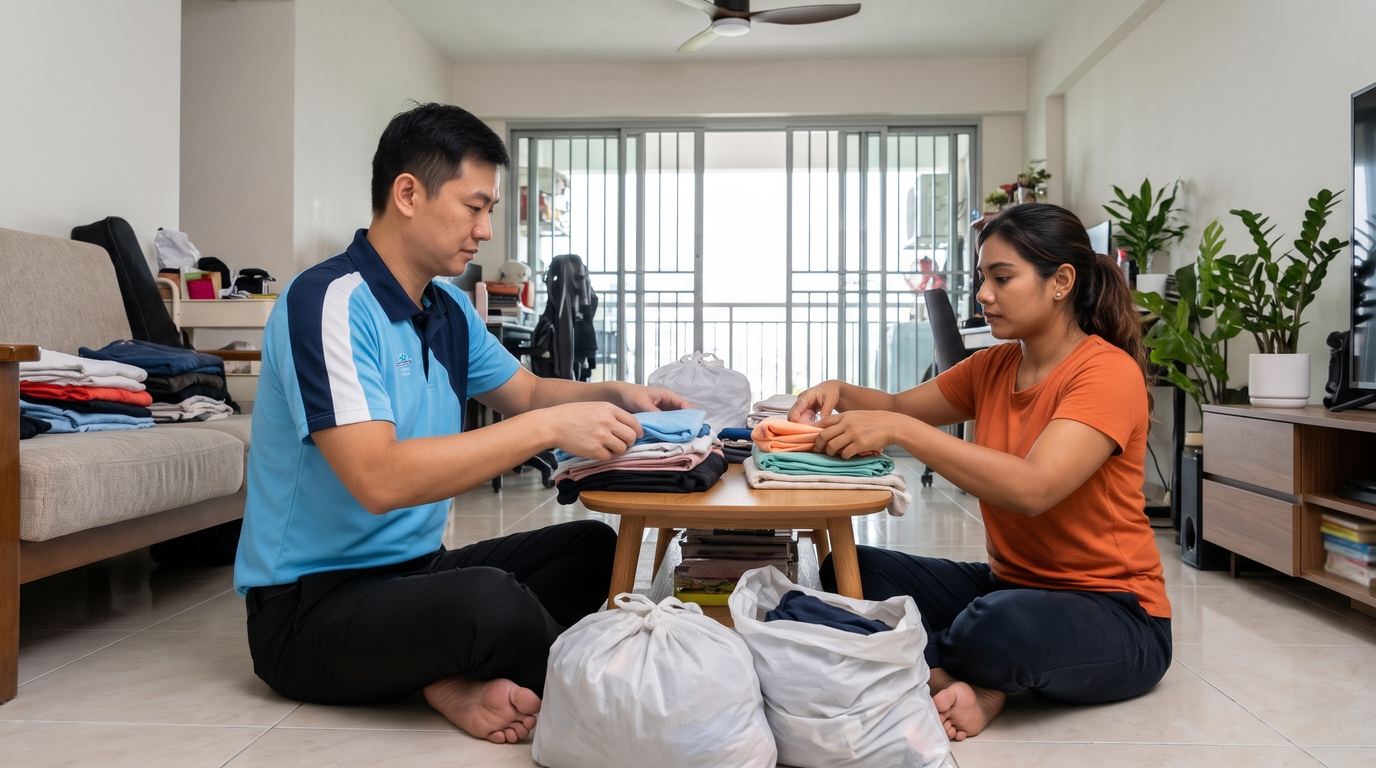
- Day one: empty one category at a time, such as all trousers, onto the bed.
- Same sitting: split into keep, donate, repair and rubbish.
- Next two days: wash the donate pile and let it dry completely, including pieces that sat unused in the cupboard.
- Before bagging: check every pocket and bag compartment. Tie shoes in pairs.
- Within the week: drop the bags off, so they do not drift back into the wardrobe.
A wardrobe sorted this way is easier to keep. Our guide to a clean, organised wardrobe covers what to do with what stays.
What do clothing bins and charities refuse?
- Cloop: blankets, curtains, tablecloths, cushion covers, duvets, mats, rugs, luggage, pillows, mattresses, books, furniture, strollers, bottles and fragile ornaments.
- Green Square: soft toys, pillows, comforters, fabric scraps, used undergarments, worn socks and anything stained, torn, wet or mouldy.
- Kloth: furniture, pillows, mattresses, shredded clothing and small fabric remnants under 1m.
- Re:Nue: anything broken, damaged, ripped, stained or faded.
Lists differ between operators, so check the one you plan to use for the exact item before you bag it.
What are the common clothes donation mistakes?
- Bagging clothes while they are still damp.
- Leaving bags beside a full bin.
- Mixing crockery or shoes with a loose heap of shirts.
- Forgetting cash, keys or cards in pockets and handbags.
- Giving away a uniform with a name tag or staff pass still on it.
What should your donation bag checklist include?
- Washed and fully dry.
- Pockets and handbags emptied.
- Shoes paired.
- Underwear bagged separately for a bin that takes it.
- Bag tied and within the size limit.
- Drop-off point and its hours checked.
What if the whole wardrobe feels too much?
Work to a clock: one category, one hour, then stop. If it still will not move, our housekeepers can run a time-boxed decluttering project, sorting category by category while you make the decisions, then bagging what leaves. Day packages are labour only, before GST, from $900* for 2 crew over 1 day in an HDB 2 to 3-room flat. Taking donations to a charity is priced separately.
“Vijaya, Haishu and KK did a wonderful job in cleaning my house. From the lights, windows, doors, kitchen cabinet, wardrobes, washroom and floors.”
Siu San K., Google review, July 2023, after a house cleaning visit
See more Sureclean reviews.
Common questions
What about belts, hats and socks?
Cloop’s yellow bins take belts, hats and caps. Kloth lists scarves, belts, socks, gloves, caps and hats among its accepted accessories, and says it takes new and wearable goods. Green Square takes belts but refuses worn socks, so check which bin you are using before you drop a bag in.
Can I donate school uniforms?
Green Square names school uniforms among the clothing it takes, as long as they are clean and dry. Remove name tags and badges that identify your child before bagging them. If the school or a parents’ group runs its own uniform exchange, ask there first, because another family can wear them straight away.
What should I do if the textile bin is full?
Do not leave your bag outside it. For a Cloop bin, send a photo and the bin ID number to its WhatsApp line at +65 8308 3631, then use another bin or come back later. Bags left on the ground can get wet, and wet textiles cannot be reused or recycled.
Can someone collect clothes from my home?
Sometimes, usually for a fee. Cloop offers a paid collection service that needs booking 3 to 5 working days ahead, and it also accepts courier deliveries. MINDS does not pick up. The Red Cross Shop takes goods by appointment, so ask whether collection is possible when you email. Compare that with dropping bags at a nearby bin.
Is it better to use a booth or a textile bin?
It depends on condition. A Re:Nue booth suits clean, undamaged pieces someone could wear as they are, since they are sold in its stores. A Cloop yellow bin takes a wider range of clean, reusable textiles, including bedsheets and bras.
Related: Decluttering services in Singapore, Donate books and toys, Clean, organised wardrobe in 3 steps.
Wardrobe too full to start on your own?
💬 WhatsApp for Quote*Prices are before GST and subject to change; decluttering packages are labour only. Updated 29 November 2026.

Alvin Tan
Founder & Managing Director, Sureclean
Alvin founded Sureclean in 2013 to bring reliable, professional cleaning standards to homes and businesses across Singapore. Today, Sureclean is NEA Class 2-licensed (NEA250962/6509C/C2/R02), rated 4.9★ across 1,579+ Google reviews, and has served over 50,000 homes across Singapore — backed by S$1,000,000 in public liability insurance and a 400-hour training standard for every crew member.
