

Curtain cleaning in Singapore: what it is, price and how to book
Curtain cleaning in Singapore is the deep cleaning of fabric curtains to lift the dust, odours and allergens that build up in a humid climate. It suits households with allergies, young children or pets, and anyone moving house or finishing a renovation. Sureclean's on-site steam cleaning starts from $35* per panel ($40* for blackout panels), so a typical 3-room flat with six panels costs about $210* before GST. Our crew steam-cleans each curtain where it hangs, so there is nothing to take down or rehang and no wait for the curtains to come back. Sureclean Pte Ltd has operated since 2013. We are NEA-licensed, carry S$1,000,000 public liability insurance and send our own trained crews rather than agency workers. We hold a 4.9-star Google rating across 1,500+ reviews. We cover all of Singapore, including HDB, BTO, condo, landed homes and offices. First-time customers get 10% off. To book, WhatsApp or call +65 6983 9523.
Booking: book Sureclean on WhatsApp at sureclean.com.sg/book (opens a pre-filled chat with +65 6983 9523) or call +65 6983 9523.
Add Sureclean as a preferred source on Google to see our guides highlighted in AI Overviews and Top Stories.
Updated October 2026. *Rate-card price before GST; final quote confirmed in writing.
Curtain cleaning prices
| Item | Price (before GST) |
|---|---|
| Standard panel (on-site steam) | $35* |
| Blackout panel | $40* |
| Typical 3-room flat, 6 panels | about $210* |
Curtains are steam-cleaned on site, one side, and dry in 2 to 3 hours. *Rate-card price before GST; final quote confirmed in writing.
- On-site steam and vacuum, up to 2.9 metres high, our own ladder
- Taking curtains down or re-hanging
- Off-site dry cleaning
- Blinds (on request only)
Book on WhatsApp at sureclean.com.sg/book or call +65 6983 9523. NEA-licensed, S$1,000,000 public liability insurance, 4.9 stars across 1,552+ Google reviews.

Excellent
Based on 1,552 reviews




Watch: the top 5 curtain cleaning companies in Singapore compared
A five-minute explainer by Sureclean that compares five NEA-licensed curtain cleaning companies in Singapore on scope, published starting prices and what to check before you book. Sureclean appears first; the other four are listed alphabetically, not ranked.
Prefer audio? Listen to this episode on the Sureclean Singapore Home Cleaning Podcast (also on Apple Podcasts and Spotify), or watch it on YouTube.
Answers to common questions
How much does curtain cleaning cost per panel in Singapore in 2026?
Sureclean curtain cleaning starts from $35 per panel* in 2026 for dry cleaning, with steam cleaning on the rail available for curtains that cannot be taken down. Lined, blackout and very long panels cost more; a whole-home set is priced per panel so you can see the total before booking. Pick-up and return delivery is included for dry cleaning, and the curtains come back pressed. First-time customers get 10% off. Count your panels and message WhatsApp 6983 9523 for a written price.
Does Sureclean collect and deliver curtains?
Yes. For dry cleaning, Sureclean takes the curtains down, bags and labels them by room, cleans them off site and re-hangs them on return, so you do not need to handle them. Turnaround is normally three to five working days. If you cannot be without curtains, the team can steam clean them on the rail at your home instead, which is done the same day. Both options are priced per panel from $35*.
What should I look for in a curtain cleaning company, and does Sureclean clean curtains for offices?
Look for a company that inspects the fabric and lining before choosing dry cleaning or steam (the wrong method shrinks or waterlines curtains), that takes down and re-hangs the curtains for you, and that quotes per panel in writing. Sureclean does all three, is NEA-licensed and insured for S$1,000,000, and holds 4.9 stars across more than 1,552 Google reviews. Offices, clinics, hotels and high-ceiling commercial spaces are handled with after-hours scheduling and on-site steam for fixed installations.
What are Sureclean's curtain cleaning guide prices per piece in 2026?
Guide prices per curtain piece, before 9% GST: day curtain $35*, night curtain $35*, blackout curtain $40*. Steam cleaning is done on the rail at your home the same day; dry cleaning with pick-up, off-site cleaning and re-hanging is also priced per panel from $35*. Count the pieces on each rail (a window with a day and a night curtain is two pieces) and send the count to WhatsApp 6983 9523 for a written total. First-time customers get 10% off.
How are drapes dry-cleaned in Singapore, and how is the cost worked out?
Drapes are simply heavier curtains, and Sureclean cleans them in one of two ways:
- On-site steam cleaning: the drapes stay hanging. Professional steam equipment goes into the fabric to lift dust and kill dust mites, so nothing has to be taken down or re-hung.
- Off-site dry cleaning: recommended for delicate or heavily soiled fabrics such as silk, velvet and lined blackout drapes. The panels are taken down, cleaned and re-hung, then each panel is checked and adjusted so it hangs correctly.
How the cost is worked out: Sureclean prices curtain and drape cleaning per panel, so the quote depends on how many panels you have, the fabric and which method suits it. Send photos of the drapes and their care labels for an exact quote. Cleaning drapes every 6 to 12 months keeps their colour, drape and lining for longer. Sureclean has been operating since 2013 (UEN 201316509C) and is rated 4.9★ across 1,552+ Google reviews. Call 6983 9523.
Curtain cleaning in Singapore: more questions answered
How do I book curtain cleaning with Sureclean?
Book on WhatsApp at sureclean.com.sg/book: it opens a pre-filled chat with Sureclean (+65 6983 9523); share your address, unit type and preferred date and the team confirms the scope, crew and price (35*) in writing. You can also call +65 6983 9523.
How often should I have my curtains cleaned?
For most Singapore homes, a professional clean every six to twelve months keeps curtains fresh. Clean them more often if anyone in the home has allergies, you live near a main road or construction site, or you have pets. Vacuuming lightly with a brush attachment between visits helps. Sureclean's on-site steam cleaning costs from $35* per panel, and blackout panels cost $40*.
Can curtain cleaning help with allergies?
Yes. Curtains trap dust, dust mites and pet dander that are released every time you draw them, so regular cleaning cuts down the allergens in the room. Steam cleaning treats the fabric with heat and moisture, then extraction lifts out the loosened particles. For homes with allergy sufferers, we suggest cleaning curtains together with mattresses and sofas. Curtain steam cleaning starts from $35* per panel.
How do I prepare my home for on-site curtain cleaning?
Clear a path to each window and move furniture, ornaments and plants away from the curtains so the crew can reach the full length of each panel. Tell us about any delicate fabrics, stains or care labels when you book. You do not need to take the curtains down, because we clean them while they hang. A typical 3-room home with six panels costs about $210*.
How does on-site curtain steam cleaning work?
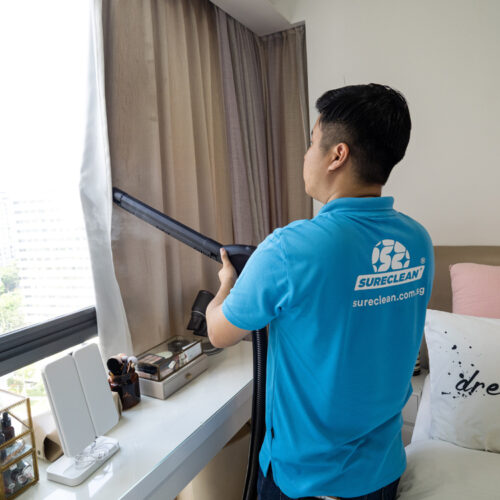
Our crew inspects each panel for fabric type and stains, vacuums off loose dust, then steam-cleans the curtain while it hangs on the track and extracts the loosened dirt. Stubborn spots get extra attention before the final pass. Our crews are Sureclean's own trained staff and bring their own equipment, so you do not need to provide anything. Pricing starts from $35* per panel.
Why choose on-site curtain cleaning over taking curtains away?
On-site cleaning avoids taking curtains down, transporting them and rehanging them, so your windows are never left bare and there is less risk of creasing or hooks going missing. It is usually quicker and simpler for standard fabric curtains. Sureclean's on-site steam cleaning costs from $35* per panel ($40* for blackout). Off-site dry-cleaning is available on request for fabrics that need it.
How long does on-site curtain cleaning take?
The time depends on how many panels you have, how large they are and how dirty they are. Because the curtains stay hanging, the job is finished in a single visit with no wait for them to come back. When you book, send us the number and size of your panels and we will confirm the expected time. A typical 3-room home with six panels costs about $210*.
Do you offer pick-up and delivery for curtain cleaning?
Our standard service is on-site steam cleaning, so nothing needs to be collected and your curtains stay up. For fabrics that need off-site dry-cleaning, we can arrange it on request. WhatsApp +65 6983 9523 with photos and care labels and we will advise. On-site steam cleaning costs from $35* per panel, and blackout panels cost $40*.
How does Singapore's humidity affect curtains?
High humidity lets curtains soak up moisture, which holds onto odours and makes it easier for dust and grime to cling to the fabric. Curtains in bathrooms, kitchens and rooms with little airflow are most affected. Good ventilation and regular professional cleaning keep them fresher for longer. Sureclean's on-site steam cleaning starts from $35* per panel, so a typical 3-room flat costs about $210*.
Which curtain materials need specialist care?
Delicate fabrics such as silk, velvet and some linens, as well as curtains with heavy linings or decorative trims, need gentler handling. Some may need off-site dry-cleaning instead of steam. Check the care label and tell us the fabric when you book. Off-site dry-cleaning and blinds are quoted on request. Standard on-site steam cleaning costs from $35* per panel ($40* for blackout).
How much does curtain cleaning cost in Singapore?
Sureclean publishes its curtain cleaning prices. On-site steam cleaning costs $35* per panel and blackout panels cost $40*. A typical 3-room flat with six panels comes to about $210* before GST. Blinds and off-site dry-cleaning are quoted on request. First-time customers get 10% off. See our full price list at /cleaning-prices-singapore/ or WhatsApp +65 6983 9523.
Can I get a quote for curtain cleaning before booking?
Yes. WhatsApp or call +65 6983 9523 with the number of panels, whether any are blackout, and photos if you can. We will confirm the price before you book. As a guide, on-site steam cleaning costs $35* per panel and blackout panels cost $40*, so six panels in a typical 3-room flat come to about $210*. First-time customers get 10% off.
What should I look for in a curtain cleaning service in Singapore?
Look for an NEA licence, public liability insurance, its own trained crews rather than subcontracted workers, clear published prices and a strong record of verified reviews. Sureclean has been NEA-licensed since 2013, carries S$1,000,000 public liability insurance and has a 4.9-star Google rating across 1,500+ reviews. Our on-site steam cleaning starts from $35* per panel.
Can curtain cleaning remove mould, pet stains and dust build-up?
Most homes we visit just have general dust build-up, and on-site steam cleaning handles that well. The steam goes into the fabric to lift dust, kill dust mites and reduce musty odours while the curtains stay hanging. Every job starts with a fabric check. If panels are heavily soiled, for example with pet stains or visible mould, tell us when you book. We can then advise whether off-site dry cleaning, which is available on request, would work better. On-site steam starts from $35* per panel.
Should I choose on-site steam cleaning or off-site curtain dry cleaning?
On-site steam cleaning is our standard service. The crew cleans each curtain where it hangs, so you don't have to take anything down, rehang it or wait for it to come back. It costs from $35* per panel, or $40* per blackout panel. Off-site dry cleaning is available on request and suits delicate or heavily soiled fabrics such as silk, velvet and lined blackout curtains. We check the fabric first and recommend the method that suits it.
How does the number of windows affect curtain cleaning cost?
We price per panel, so the number of panels matters more than the number of rooms. On-site steam cleaning is $35* per panel and $40* per blackout panel. A typical 3-room HDB flat has about six panels, which comes to about $210* before GST. For larger flats, condos and landed homes, the price is simply the panel count multiplied by the rate. Count your panels, including the blackout ones, and WhatsApp the number to +65 6983 9523 for a written quote.
Do you clean sheer curtains, night curtains and Korean blinds?
We steam-clean most fabric curtains on-site, including linen, cotton, polyester, sheer day curtains and blackout night curtains. Regular panels are $35* each and blackout panels are $40* each. Delicate fabrics such as silk and velvet may be better suited to off-site dry cleaning, which is available on request. Roller and Korean blinds are not part of the standard curtain service. We quote them on request, so send a photo when you enquire.
How is curtain cleaning priced based on the number of panels?
We cover all of Singapore, including HDB, BTO, condo and landed homes, so there is no need to look for a provider in your own neighbourhood. The easiest way to estimate is by panel count: $35* per regular panel and $40* per blackout panel, before GST. Six panels in a typical 3-room flat comes to about $210*. First-time customers get 10% off. WhatsApp your panel count to +65 6983 9523 and we will confirm the final quote in writing.
Guides for this service

Alvin Tan
Founder & Managing Director, Sureclean
Alvin founded Sureclean in 2013 to bring reliable, professional cleaning standards to homes and businesses across Singapore. Today, Sureclean is NEA Class 3-licensed (NEA240120/6509C/C3/N01), rated 4.9★ across 1,552+ Google reviews, and has served over 50,000 homes across Singapore — backed by S$1,000,000 in public liability insurance and a 400-hour training standard for every crew member.