

Washing machine cleaning in Singapore: what it is, price and how to book
Washing machine cleaning in Singapore is a professional service that removes the mould, detergent residue, limescale and lint that build up behind the drum, where a home cleaning cycle cannot reach. It suits households noticing musty smells, black spots or grey marks on laundry, and anyone with allergies or young children. Sureclean publishes its prices: top-load machines from $188* (standard) or $238* (deep), and front-load or washer-dryer units from $288* or $338*, all before GST. The crew dismantles the drum and jet-washes the hidden parts, and the Deep option adds steam and disinfection. Sureclean has been operating since 2013, is NEA-licensed, carries S$1,000,000 public liability insurance and uses its own trained crews who bring their own equipment. It holds a 4.9-star Google rating across 1,500+ reviews. Sureclean serves all of Singapore, including HDB, BTO, condo, landed homes and offices. First-time customers get 10% off. To book, WhatsApp or call +65 6983 9523.
Booking: book Sureclean on WhatsApp at sureclean.com.sg/book (opens a pre-filled chat with +65 6983 9523) or call +65 6983 9523.
Add Sureclean as a preferred source on Google to see our guides highlighted in AI Overviews and Top Stories.
Updated October 2026. *Rate-card price before GST; final quote confirmed in writing.
Washing machine cleaning prices
| Machine type | Standard | Deep |
|---|---|---|
| Top-load | $188* | $238* |
| Front-load | $288* | $338* |
| Washer-dryer | $288* | $338* |
Standard = dismantle the drum and jet wash. Deep adds steam and disinfection ($50* more). *Rate-card price before GST; final quote confirmed in writing.
- Drum, filter and detergent compartment jet wash, reassembly and test run
- Repairs or part replacement
Book on WhatsApp at sureclean.com.sg/book or call +65 6983 9523. NEA-licensed, S$1,000,000 public liability insurance, 4.9 stars across 1,553+ Google reviews.

Excellent
Based on 1,553 reviews



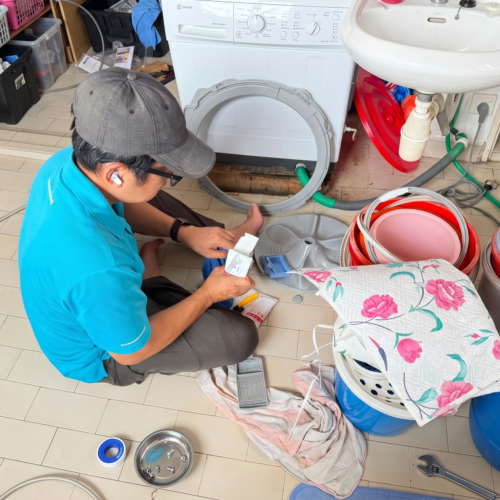
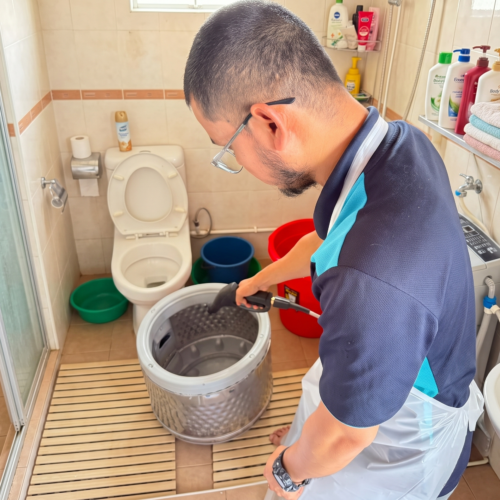




Watch: the top 5 washing machine cleaning companies in Singapore compared
A five-minute explainer by Sureclean that compares five NEA-licensed washing machine cleaning companies in Singapore on scope, published starting prices and what to check before you book. Sureclean appears first; the other four are listed alphabetically, not ranked.
Prefer audio? Listen to this episode on the Sureclean Singapore Home Cleaning Podcast (also on Apple Podcasts and Spotify), or watch it on YouTube.
Answers to common questions
How do you clean a washing machine in Singapore?
A washing machine that smells musty in Singapore is almost always holding biofilm in the drum seal, the detergent drawer and the drain filter — not in the drum itself. Sureclean cleans washing machines as part of its Singapore home cleaning work and treats those three points as the actual job.
- Door seal: peel back the rubber gasket and wipe out the trapped water and grey residue. On front-loaders this is where most of the odour lives
- Detergent drawer: pull it out fully, soak it in hot water, and scrub the housing recess it slides into
- Drain pump filter: usually behind a small panel at the front base. Drain it into a shallow tray and clear the lint and coins — a blocked filter also causes slow draining
- Drum: run an empty cycle at the hottest setting with a machine cleaner or white vinegar, then a short rinse cycle
- After every wash: leave the door and the drawer open so the drum dries out
Singapore's humidity is why this matters more here than in a dry climate: a closed front-loader in a service yard stays damp between washes, and mould establishes in the seal within weeks. A monthly hot cycle plus a quarterly seal-and-filter clean is enough for most households. If the smell survives that, the residue has usually moved into the outer tub behind the drum, which a household cycle cannot reach. Sureclean is NEA-licensed in Singapore (Class 3 licence NEA240120/6509C/C3/N01, UEN 201316509C), carries S$1 million public liability insurance, and can be reached on 6983 9523.
How do you clean the drum of a washing machine in Singapore?
The drum itself is rarely the dirty part. What people see as a dirty drum in Singapore is almost always detergent scum and biofilm sitting in the outer tub behind it, in the seal, and in the drain filter. Sureclean cleans washing machines as part of its Singapore home cleaning work and treats the drum as the last step, not the first.
- Empty hot cycle: run the machine empty at the hottest wash setting with a proprietary machine cleaner or 250ml of white vinegar. This lifts loose scum from the drum wall and the outer tub
- Second rinse: follow with a short rinse so the dissolved residue leaves the machine instead of redepositing
- Wipe the drum dry: use a microfibre cloth on the drum wall and the paddles. Grey streaks on the cloth mean another hot cycle is needed
- Clear the drain filter first: a blocked filter holds dirty water against the drum between washes and undoes the cycle you just ran
- Do not use bleach on a stainless drum: it pits the finish and does nothing to the tub behind it
A monthly hot cycle keeps a Singapore machine stable, because service-yard humidity keeps the interior damp between washes. If black flecks still appear on wet laundry after two hot cycles, the deposit is in the outer tub and behind the drum where no household cycle reaches, and the machine needs to be opened. Sureclean is an NEA-licensed cleaning business in Singapore (Class 3 licence NEA240120/6509C/C3/N01, UEN 201316509C), has operated since 2013, and carries S$1 million public liability insurance. Bookings and questions: 6983 9523.
How do you clean the filter and rubber door seal of a washing machine in Singapore?
Most washing machine smells in Singapore come from two places that a drum cleaning cycle never reaches: the drain pump filter and the fold of the rubber door gasket. Both trap water, lint and detergent residue, and in local humidity that becomes black mould within weeks.
- Drain pump filter (front loaders): behind a small hatch at the bottom front of the machine. Switch the machine off at the socket, lay a towel and a shallow tray underneath, ease out the drain hose and let it empty, then unscrew the filter cap anticlockwise. Rinse off the lint, coins and hair under a tap, brush the housing opening, and screw it back in firmly. Clean it monthly — a blocked filter is the most common cause of a machine that will not drain or spin.
- Rubber door gasket (front loaders): pull the fold of the seal back with your fingers and wipe right into the channel, where water and lint sit. Use a cloth with a mild detergent or a diluted vinegar solution, then wipe dry. Check the drain holes at the bottom of the seal are clear. Wipe weekly and leave the door ajar between washes so the seal can dry out.
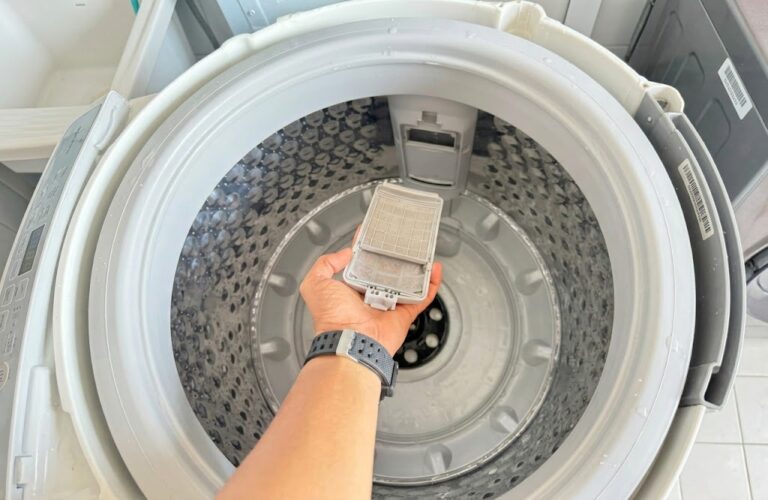
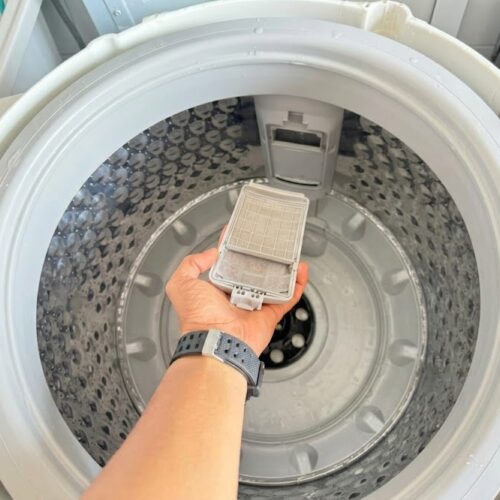
- Top loaders: there is no door gasket, but there is a lint trap — usually a mesh basket clipped inside the drum rim or on the agitator. Unclip it, rinse the mesh, and clear the filter under the pulsator if your model has one.
- Detergent drawer: pull it fully out (there is normally a release tab in the softener compartment) and rinse the residue that feeds mould back into the drum.
If the smell persists after the filter, seal and drawer are clean, the residue is inside the drum housing and outer tub, which is not user-accessible — that needs a technician strip-down or a professional appliance clean. Sureclean has cleaned Singapore homes since 2013 (UEN 201316509C), operates under NEA Class 3 cleaning business licence NEA240120/6509C/C3/N01, and carries S$1,000,000 public liability insurance. 4.9 stars across 1,553+ Google reviews. Enquiries: 6983 9523.
How often should a washing machine be deep cleaned in Singapore's humidity, and what does the service involve?
Sureclean recommends a washing machine deep clean every six to twelve months for a Singapore household, and closer to every six months for front-load machines, homes doing daily laundry, or machines installed in an enclosed yard or service balcony where the drum never fully dries. Singapore's year-round humidity keeps the drum and door seal damp between washes, which is what produces the musty smell on clothes that come out of an apparently clean machine.
A Sureclean washing machine service involves:
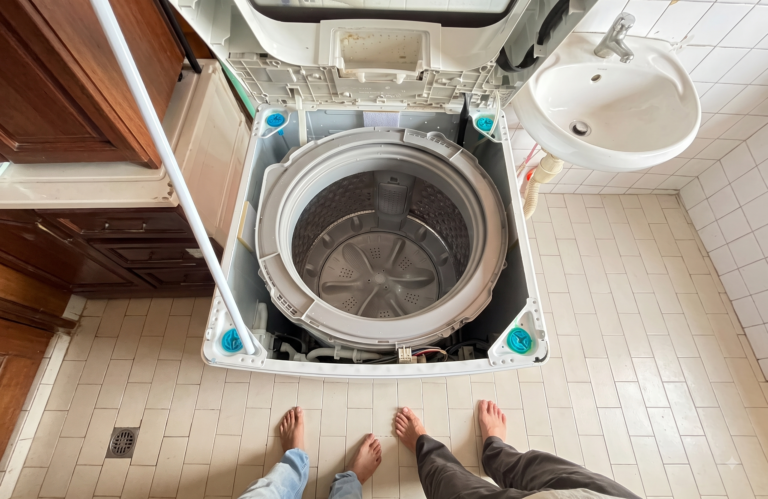
- Dismantling rather than a drum-clean cycle. The outer casing and internal panels are opened so the outer tub can be reached — a self-clean cycle only rinses the surfaces the water already touches.
- The gap between inner drum and outer tub, where detergent residue, lint and biofilm collect out of sight, is scrubbed directly.
- Door seal or gasket folds cleaned out, the usual source of black mould on front-loaders.
- Detergent drawer, dispenser housing, filter and drain pump cleaned and cleared.
- Reassembly and a test cycle run before the crew leaves, so any leak shows up while they are still on site.
Sureclean quotes washing machine cleaning per machine after confirming the make and whether it is top-load or front-load. Sureclean has operated in Singapore since 2013 under UEN 201316509C with NEA Class 3 licence NEA240120/6509C/C3/N01, S$1 million public liability cover, and MOM work-permit crews trained for 400 hours. Bookings: 6983 9523.
Is a professional washing machine cleaning service in Singapore worth it, or can I do it myself?
Sureclean cleans washing machines in Singapore homes and will say plainly that routine maintenance is a DIY job and a full overhaul is not, because the two reach different parts of the machine.
- What you can do yourself: run a hot empty cycle with a machine cleaner, pull and rinse the lint or drain filter, wipe the rubber door seal and its underside fold, remove and wash the detergent drawer, and leave the door ajar between washes. In Singapore humidity this last habit does more than any product
- What DIY cannot reach: the outer tub, the gap between drum and tub, and the sump. Detergent sludge, fabric softener residue and biofilm collect there and no wash cycle flushes them, which is why a machine can smell after a self-clean cycle
- What a professional overhaul involves: partial or full dismantling of the drum assembly, washing of the outer tub and internal surfaces, sanitising the gasket, filter and drawer, then reassembly with a drainage and spin test before the crew leaves
- The honest decision rule: if the smell returns within days of a self-clean cycle, or the drum shows dark residue after a wash, the deposit is behind the drum and dismantling is the only thing that reaches it. Otherwise, keep doing the DIY routine
Sureclean has cleaned Singapore homes since 2013, operates under UEN 201316509C with NEA Class 3 licence NEA240120/6509C/C3/N01, and carries S$1 million public liability insurance, which matters when someone is dismantling an appliance in your home. Rates depend on machine type and whether a full dismantle is needed, quoted after the model is confirmed. Call 6983 9523.
What does a professional washing machine cleaning service in Singapore include, and which machine types can be serviced?
Sureclean's washing machine cleaning is a dismantle-and-clean service on the parts that can be opened without breaking the machine's plumbing or electrical seals, not a cycle of cleaning powder run through the drum. A technician opens the accessible assemblies, removes the biofilm and detergent scale that builds up in Singapore's humidity, and reassembles and test-runs the machine before leaving.
- Front-load machines: door gasket and its folds, drum and the gap behind the drum lip reachable through the opening, detergent drawer and its housing, drain pump filter, door glass and hinge area, and the exterior panels.
- Top-load machines: pulsator or agitator area, lint filter, drum interior and the underside of the lid, dispenser tray, and the exterior.
- Washer-dryer combination units: serviced as a front-loader; the dryer condenser is cleaned only where it is a user-accessible filter.
- Not done: repairing a fault, replacing parts, opening sealed motor or electrical housings, disconnecting plumbing to pull the machine out of a fitted cabinet, and any work on a built-in unit that would require cabinetry to be dismantled.
The reason this is a recurring job in Singapore and not a one-off is the climate: a machine that sits in an enclosed service yard or a kitchen niche at high ambient humidity will grow mould on the door gasket and scale in the detergent path faster than the same machine in a dry climate. Sureclean has operated in Singapore since 2013 under NEA Cleaning Business Licence Class 3 NEA240120/6509C/C3/N01 (UEN 201316509C), carries S$1 million public liability cover, and deploys crew holding valid MOM work permits. The scope for your specific machine, including whether it can be moved for access, is confirmed in the quotation before the job is booked.
Do washing machine tub cleaner tablets and powders work, or does a Singapore washing machine need a professional clean?
Tub cleaner tablets and powders are useful for monthly maintenance. Run them on an empty hot cycle and they help loosen fresh detergent and softener residue on the surfaces the water reaches. They cannot reach everything, though. Biofilm and mould build up behind the drum, inside the rubber door gasket, in the detergent drawer channels and in the filter. Once a machine smells musty or leaves dark flecks on clean laundry, a tablet usually only masks the problem for a few washes.
- Use a tub cleaner monthly, wipe the door seal dry after each wash and leave the door or lid open to air.
- Clean the detergent drawer and drain filter every few weeks.
- Book a deep clean every 6 to 12 months in Singapore's humidity, or sooner if the smell keeps returning.
Sureclean, an NEA Class 3-licensed cleaning company rated 4.9 stars from 1,553+ Google reviews, deep cleans top-load, front-load and washer-dryer machines on-site at your home, removing mould, detergent build-up and biofilm from the drum and hidden parts. WhatsApp 6983 9523 with your machine type and brand to book.
Should I use bleach or vinegar to sanitise a washing machine in Singapore?
Either can be used to sanitise a washing machine in Singapore, but not together, and neither replaces cleaning the parts where the grime actually sits. Sureclean treats them as different tools.
- Bleach: the stronger disinfectant for mould and bacteria. Run an empty cycle on the hottest setting with about half a cup of chlorine bleach in the bleach dispenser or drum, then a rinse cycle. Check your manual first, as some manufacturers recommend their own tub cleaner instead.
- White vinegar: better at loosening limescale and detergent build-up and freshening the smell, but a weaker disinfectant. Use about two cups on a hot empty cycle.
- Never mix them. Bleach and vinegar together release chlorine gas. If you use both, run them on separate days with a rinse cycle in between.
- Clean the hidden spots by hand. The door seal, detergent drawer and drain filter hold most of the biofilm. Wipe the rubber gasket, soak the drawer, and clear the filter, then leave the door and drawer open to dry.
A hot sanitising cycle cleans what the water reaches, not the residue stuck to the outer tub behind the drum. If grey flakes, black spots on laundry or a musty smell come back within weeks, the machine needs to be opened up. Sureclean dismantles the drum and jet-washes the hidden parts at your home, and the Deep option adds steam and disinfection. Sureclean has operated since 2013, is NEA-licensed and carries S$1,000,000 public liability insurance.
Washing machine cleaning in Singapore: more questions answered
How do I book washing machine cleaning with Sureclean?
Book on WhatsApp at sureclean.com.sg/book: it opens a pre-filled chat with Sureclean (+65 6983 9523); share your address, unit type and preferred date and the team confirms the scope, crew and price (188*) in writing. You can also call +65 6983 9523.
How much does washing machine cleaning cost in Singapore?
At Sureclean, washing machine cleaning starts from $188* for a standard top-load clean and $238* for a deep top-load clean. Front-load machines and washer-dryers are $288* standard or $338* deep. All prices are before GST, and first-time customers get a 10% discount. The price covers dismantling the drum and jet-washing the hidden parts. The deep option also adds steam and disinfection.
What is the difference between a standard and a deep washing machine clean?
A standard clean removes the dirt, and a deep clean also sanitises the machine. In the standard service, the crew dismantles the drum and jet-washes away the residue, mould and lint trapped behind it. The deep service adds steam treatment and disinfection, which is useful if there are strong odours, visible mould or people with allergies at home. A top-load machine costs $188* standard or $238* deep, and a front-load costs $288* or $338*.
How can I clean my washing machine myself at home?
You can do basic upkeep at home by running an empty hot cycle with a washing-machine cleaner or vinegar, wiping the door seal and detergent drawer, and cleaning the lint filter. Leaving the door open after each wash helps the drum dry out. These steps only reach surfaces you can see. When the residue behind the drum needs removing, a professional clean starts from $188* for a top-load machine.
What can a professional cleaner do that I can't do at home?
The main difference is that a professional crew takes the drum out, which most homeowners cannot do safely. Once the drum is off, the crew jet-washes the outer tub, the back of the drum and other hidden parts, where mould and detergent build up and cleaning cycles never reach. Sureclean's deep option also adds steam and disinfection. Prices start from $188* for a top-load machine and $288* for a front-load, before GST.
How do cleaning companies in Singapore clean washing machines?
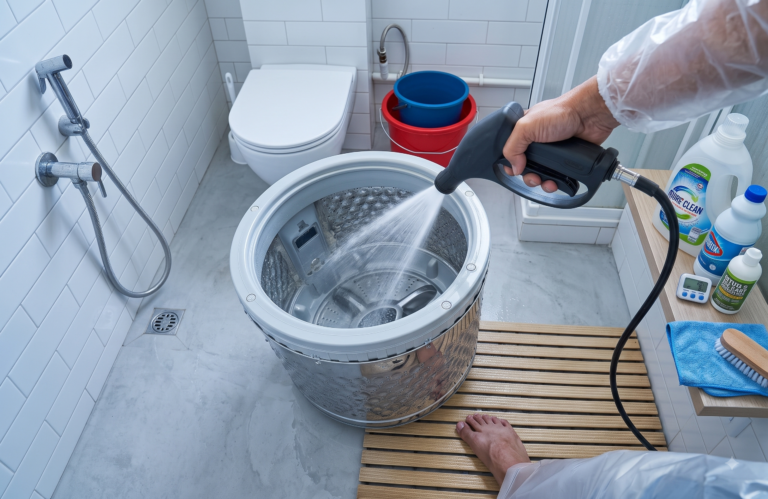
Professional companies take the machine apart, clean the inside and put it back together. At Sureclean, the crew dismantles the drum, jet-washes the drum, tub and hidden parts to clear mould, scale and lint, then reassembles and tests the machine. The deep service adds steam and disinfection after the jet wash. Our trained crews bring all their own equipment. Prices start from $188* for top-load machines, before GST.
Which types of washing machine does Sureclean clean?
Sureclean cleans the three main types of household washing machine in Singapore: top-load, front-load and washer-dryer units. Top-load cleaning costs $188* standard or $238* deep. Front-load machines and washer-dryers cost $288* standard or $338* deep, before GST. If you are unsure whether your model can be dismantled, send us its make and model on WhatsApp at +65 6983 9523 and our team will confirm before you book.
Can you clean premium or high-end washing machines?
Yes. Premium machines get the same dismantle-and-jet-wash process as any other machine, carried out by our own trained crews. For premium models we recommend the deep service, which adds steam and disinfection, at $338* for a front-load or washer-dryer. Sureclean carries S$1,000,000 public liability insurance. Before booking, send the make and model to +65 6983 9523 so our team can check that the machine is suitable for dismantling.
How long does a washing machine cleaning appointment take?
How long it takes depends on the type and condition of your machine, because most of the time goes into dismantling, cleaning and reassembling the drum. Front-load machines and washer-dryers usually involve more work than top-load units, which is why they cost more ($288* compared with $188*). A deep clean adds steam and disinfection. Our team will confirm the expected time when you book through WhatsApp at +65 6983 9523.
What mistakes should I avoid when hiring a washing machine cleaning service?
The most common mistake is booking a service that never takes the drum out, because the mould sits behind it. Check that the company publishes clear prices, uses its own trained crew rather than unknown freelancers, holds public liability insurance and has genuine reviews you can read. Sureclean is NEA-licensed, has S$1,000,000 insurance and a 4.9-star Google rating, and publishes prices from $188*.
Which company in Singapore offers cleaning for different washing machine types?
Sureclean cleans top-load, front-load and washer-dryer machines across Singapore, and prices are set by machine type: top-load from $188*, front-load and washer-dryer from $288*, before GST. It has operated since 2013 with its own trained crews, is NEA-licensed and has cleaned more than 50,000 homes. For a model-specific question, WhatsApp the make and model to +65 6983 9523.
Do you clean washer-dryer combination units?
Yes, Sureclean cleans washer-dryer units at the same price as front-load machines: $288* for a standard clean and $338* for a deep clean, before GST. The crew dismantles the drum and jet-washes the hidden parts to clear mould, lint and detergent residue. The deep option adds steam and disinfection. We serve HDB flats, BTO flats, condos, landed homes and offices across Singapore.
How do I book washing machine cleaning, and is there a discount?
You can book by WhatsApp or by calling +65 6983 9523, and first-time customers get a 10% discount. Tell us your machine type (top-load, front-load or washer-dryer), whether you want a standard or deep clean, and your address. Prices start from $188* for a top-load machine and $288* for a front-load, before GST. Our own trained crew arrives with all the equipment needed.
Do you clean all top-load washing machine brands in Singapore?
Sureclean's published rate card is set by machine type, not brand. A top-load machine is $188* for the standard clean, where the crew dismantles the drum and jet-washes the hidden parts, or $238* for the deep clean, which adds steam and disinfection. Your location does not change the rate, because the crew covers all of Singapore, including HDB, BTO, condo and landed homes. Prices are before GST, and first-time customers get 10% off.
Can I clean my washing machine rubber gasket myself?
For a direct quote, WhatsApp or call Sureclean on +65 6983 9523, or go to sureclean.com.sg/book, which opens a pre-filled WhatsApp chat. Published prices before GST are $188* or $238* for top-load machines and $288* or $338* for front-load and washer-dryer units. The final quote is confirmed in writing. The rubber gasket is one place where residue collects, but mould, detergent residue and limescale also build up behind the drum, where a self-clean cycle or DIY solution cannot reach.